
How to Choose the Right Stacker for Warehouse Material Handling
Most stacker purchases go wrong for a simple reason: businesses pick based on what's available or familiar, not on what their operation actually needs. A supplier pushes what they have in stock, a manager copies what a previous employer used, and the result is equipment that's either overpowered for the job or straining under it.
There's no single best stacker. There's only the one that matches your load weight, how often it gets used, your warehouse layout, and the shape of what you're lifting. This guide breaks down how to find the right warehouse material handling equipment for your specific operation.
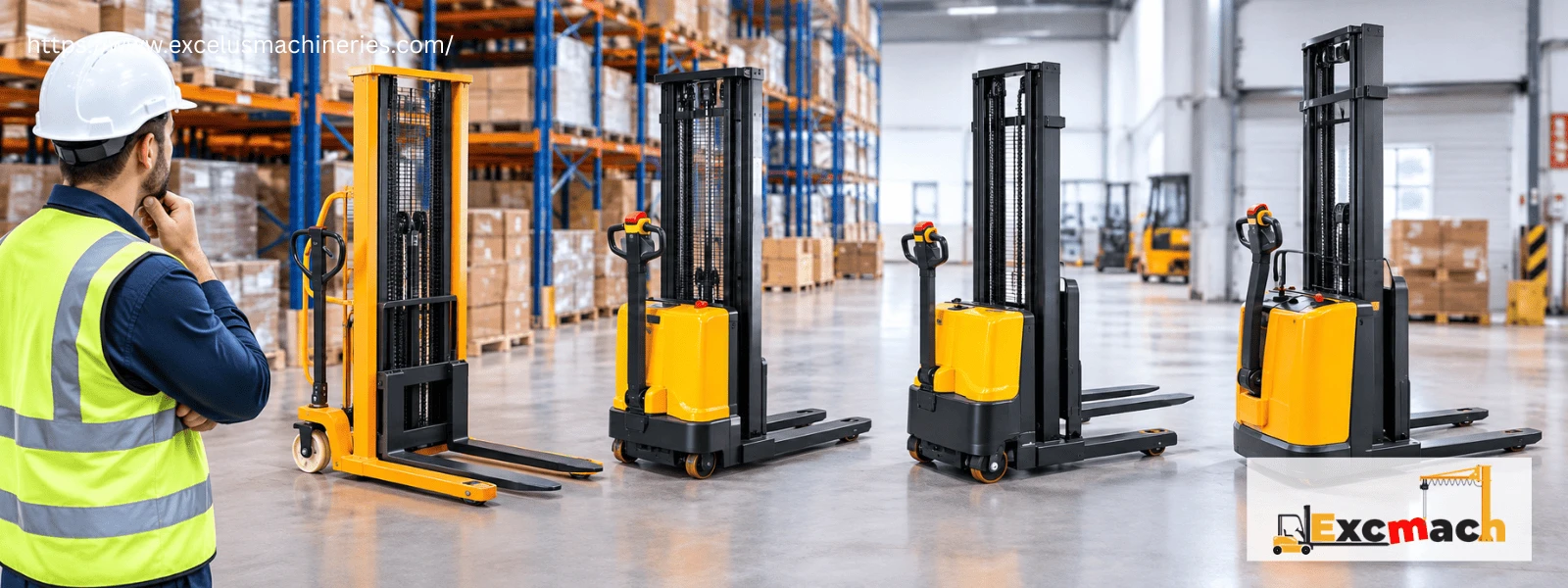
Quick Stacker Selection Table
Warehouse Requirement | Recommended Stacker | Why |
Light and occasional lifting | Manual Stacker | Simple operation with lower equipment and maintenance requirements |
Regular lifting with moderate usage | Semi Electric Stacker | Powered lifting reduces manual pumping effort |
Frequent lifting and travel | Full Electric Stacker | Electric lifting and travelling support higher-use operations |
Paper rolls, reels or cylindrical loads | Paper Roll Stacker | Designed to securely support cylindrical loads |
If You're Lifting Occasionally and the Loads Are Light
This is more common than most people assume, and it's also where businesses most often overspend. If your team is lifting pallets a handful of times a day, and none of those loads are especially heavy, you almost certainly don't need anything powered.
A manual stacker handles this without complication. There's no battery to charge, no motor to maintain, and the upfront cost is a fraction of anything electric. The tradeoff is operator effort someone has to pump the hydraulic lever by hand but if that's happening five or ten times a shift rather than fifty, it's rarely a real problem. Smaller retail backrooms, low-volume storage areas, and any material handling stacker that spends most of the day sitting idle between uses tend to fall squarely into this category.
If Loads Are Heavier or Lifting Happens All Day
Here's where hand-pumping stops being a minor inconvenience and starts being an actual bottleneck. Once operators are visibly slower by the end of a shift, or heavier loads mean each pump takes real effort, it's worth looking at a semi-electric stacker.
A semi-electric stacker powers the lift but leaves the operator to walk the unit into position. That's usually enough most of the fatigue in manual stacking comes from the lifting itself, not the walking. It also costs less to buy and maintain than a fully powered unit, since there's no drive motor or travel controls to worry about, just the battery and pump handling the lift. We've gone deeper into where this option earns its keep in our guide to semi-electric stackers, including the specific signs that it's time to move up from manual.
If the Stacker Barely Stops Moving
Some operations don't have "occasional" or "moderate" lifting the equipment is in near-constant use, covering long aisle runs, or getting handed off between multiple operators across a shift. That's a different category of problem, and it calls for a full electric stacker, which powers both the lift and the travel.
This is the equipment worth the higher cost specifically because the volume justifies it. A full electric stacker sitting idle most of the day is an expensive mistake; one running continuously in a high-throughput warehouse pays for itself in reduced fatigue and steadier cycle times, especially late in a shift when a manual or semi-electric setup would normally start slowing down. Our breakdown of full electric stacker features and benefits covers exactly where that line sits.
If You're Handling Rolls, Reels, or Drums
None of the above matters much if your actual problem is shape, not weight or frequency. Paper reels, textile rolls, film, and similar cylindrical loads don't sit stably on flat forks no matter how the lift is powered the load wants to roll or shift the moment it's lifted, and that risk gets worse the higher it goes.
This calls for equipment built specifically for that shape. A paper roll stacker uses a curved cradle attachment instead of flat forks, which holds the roll securely along its length rather than balancing it on two narrow points. Many models also let the operator rotate the roll before setting it down, which matters since rolls often need to feed into machinery at a specific angle. If this describes your warehouse, treat it as a separate decision from the manual-versus-electric question above the attachment shape matters more here than how the lift is powered.
What the Category Alone Won't Tell You
Even once you know which type fits manual, semi-electric, full electric, or a specialized configuration two things still need checking before you buy, and both get overlooked more often than you'd expect.
The first is your aisle width and turning radius. Every one of these stacker types comes in different footprints, and a machine that looks compact in a photo can still be too wide for a genuinely narrow aisle. Measure your tightest corner, not your average one, and check it against the specific model's actual dimensions rather than assuming a category implies a particular size.
The second is your actual racking height. This one's easy to underestimate, because a small shortfall in lift height doesn't just look wrong on a spec sheet it means an entire top shelf of racking becomes practically unreachable. Measure your tallest level directly rather than trusting a rough guess, and build in some margin rather than cutting it exactly to the number.
Floor conditions deserve a mention too, particularly in facilities with ramps, uneven surfaces, or dock areas. Not every stacker is rated for the same floor conditions, and this is worth confirming before delivery rather than discovering it on the warehouse floor.
Every stacker in this discussion, regardless of type, falls under what's broadly known as a hydraulic stacker, since manual, semi-electric, and full electric units all lift using a hydraulic pump rather than a chain or scissor mechanism. Excelus Machineries' hydraulic stacker range covers this entire spread, including the paper roll configuration, which is worth a look before comparing across separate product lines.
Mistakes Worth Avoiding
Buying more automation than the operation needs is the single most expensive mistake on this list. A full electric stacker for light, occasional lifting is solving a problem that a manual unit already handles for a fraction of the cost, and the added expense of batteries, motors, and charging infrastructure rarely pays for itself in that situation.
Underestimating aisle width until the equipment actually arrives is close behind it. Redesigning a layout or returning a unit after delivery costs far more than measuring beforehand would have, and it's one of the most avoidable mistakes on this entire list.
Assuming every industrial stacker in a given category is interchangeable causes more quiet problems than either of those. A warehouse stacker rated for one load range doesn't automatically suit another, even within the same broad type capacity, lift height, and footprint can all differ meaningfully between models that look nearly identical on a product page.
And skipping operator training because the equipment feels more automated is a habit worth breaking. Powered controls take away physical effort, not the responsibility for safe load positioning, sensible travel speed, or a basic pre-use check that holds true whether the stacker is manual or fully electric, and it's covered in more detail in our safety guidelines for stacker operators.
Practical Factors for Selecting a Warehouse Stacker
Selecting a stacker should be based on the actual working conditions of the warehouse rather than equipment category alone. Material weight, lifting height, operating frequency, aisle dimensions, floor conditions, and load shape can all affect the suitability of a particular configuration.
For industrial applications, buyers should also verify the manufacturer's stated load capacity, lifting range, dimensions, operating requirements, and available technical support before making a purchase. Matching the equipment specification to the intended application helps avoid selecting a machine that is either unnecessarily large or unsuitable for the working environment.
Where Excelus Machineries Fits
Excelus Machineries is a Vapi-based material handling equipment supplier, and for most of the situations described above, the hydraulic stacker range covers what's actually needed manual configurations for lighter, occasional work, and the paper roll stacker for reel-based handling that a standard unit isn't shaped for. Rather than piecing together equipment from several suppliers, most warehouses find one product family covers the bulk of what they actually need.
If you're weighing whether stackers earn their place in your operation at all, the general benefits of stacker machines is worth a read before anything else.
Once you know roughly which situation above describes your operation, reach out to the team with your load weight, usage frequency, and aisle dimensions that's usually enough to get a straightforward recommendation without wading through spec sheets yourself.
Final Takeaway
The right stacker for warehouse material handling isn't the most advanced one available it's the one that actually matches your load weight, how often it gets used, your warehouse layout, and the shape of what you're lifting. Most buying mistakes come from skipping one of those four factors, not from picking the wrong brand.
Recent Insights
View AllFrequently Asked Questions
Not quite. Hydraulic stacker describes the lifting mechanism itself a hydraulic pump which applies across manual, semi-electric, and full electric units. Electric stacker specifically refers to the powered versions within that broader family.