
Full Electric Stacker: Features, Benefits & Industrial Applications
If you've ever watched a warehouse crew struggle through the last couple of hours of a double shift, you already know what drives businesses toward a full electric stacker. The pumping arm gets heavier to push down. The unit gets harder to shove across the floor. None of that is about effort or attitude it's just what happens to a body after enough repetitions on a manual stacker. At some point, the equipment needs to start doing more of the work.
This article gets into what a full electric stacker actually is, how it compares to manual and semi-electric alternatives, where it genuinely earns its cost, and what's worth checking before buying one. It's written for warehouse managers, plant operations leads, and procurement teams sizing up stacker options for higher-volume material handling.
What a Full Electric Stacker Is Best For
A full electric stacker powers both the lifting and the driving, which makes it the right call when a stacker is in near-constant use, covering long aisle runs, or getting passed between operators across a shift. If your lifting needs are occasional rather than constant, a manual stacker usually covers it for a lot less money. Everything below explains how to tell which side of that line your operation sits on.
What Is a Full Electric Stacker?
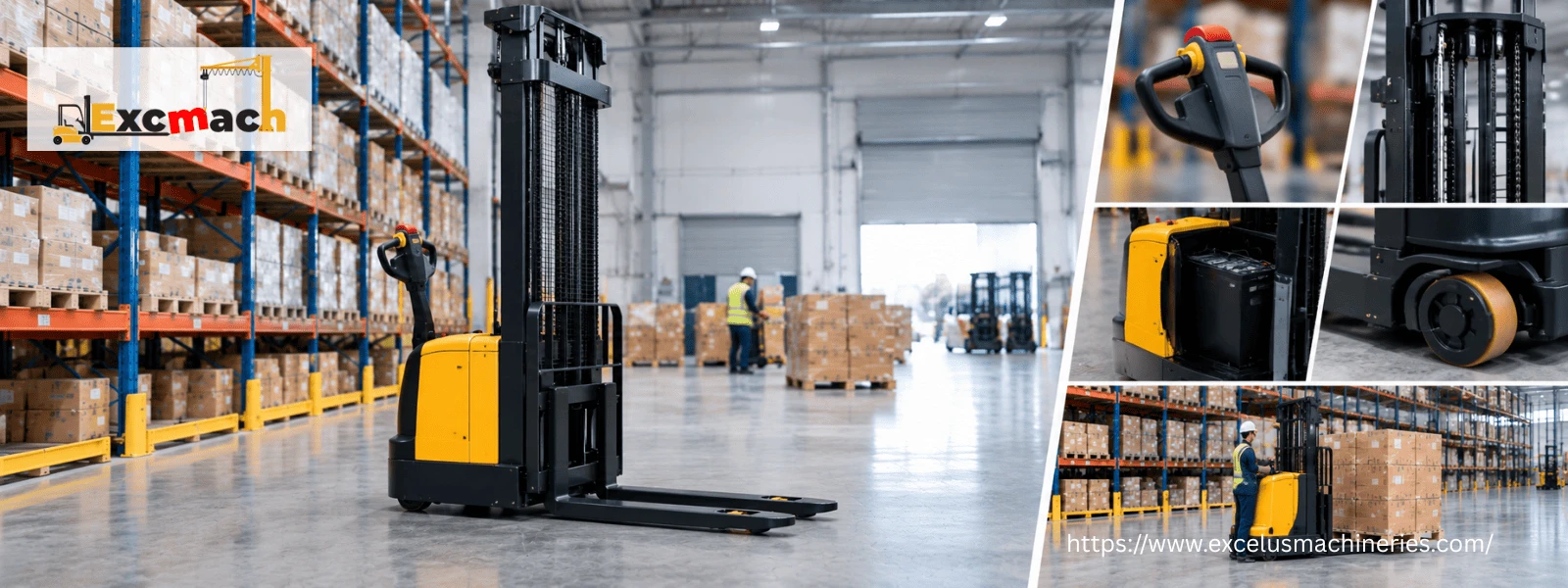
Strip away the marketing language and it's fairly simple: a full electric stacker is a battery-powered unit where both the lift and the travel are motorized, instead of relying on someone to hand-pump a lever or physically push the machine across the floor. A manual stacker leaves both jobs to the operator. A semi-electric stacker takes the lifting off their plate but still has them walking or steering it into place by hand. A full electric stacker removes both.
In practice, the operator works from a tiller or control panel raising, lowering, and driving through buttons and a steering handle rather than muscle. It doesn't sound dramatic written out like that, but multiply it across dozens of cycles a shift and it changes what the job actually feels like by the end of the day.
Full Electric Stacker vs. Manual and Semi-Electric Stackers
The three types sit on a spectrum of how much physical effort gets handed off from the operator to the machine.
A manual stacker asks for both lifting and moving by hand. It works fine where usage is occasional lower cost, no charging setup to plan around, less to maintain beyond the hydraulics. The catch is that fatigue shows up fast once usage climbs past "occasional."
A semi-electric stacker splits the difference: the lift is powered, so raising heavier loads doesn't wear anyone out, but the operator still walks the unit into position. It suits moderate, steady use where full automation of travel isn't really necessary.
A full electric stacker takes both jobs away from the operator entirely, which is what earns its cost where the equipment barely stops moving through a shift long aisle runs, high cycle counts, multiple operators sharing the same unit across the day.
Stacker Type | Lifting | Travel | Best Suited For |
Manual Stacker | Hand-pumped | Manually pushed | Occasional use, tighter budgets |
Semi-Electric Stacker | Powered | Manually walked/steered | Moderate, regular lifting frequency |
Full Electric Stacker | Powered | Powered | High-frequency use, longer aisle runs, multi-operator shifts |
Key Features That Define a Full Electric Stacker
The battery is the obvious starting point both lift and drive run off it, and that's really the core difference from the other two categories. Battery type and charge cycle vary between models, so it's worth pulling the actual spec sheet for a unit you're considering rather than assuming it matches something you've used before.
Control changes too. Instead of a hand-pump lever, you're working a tiller or panel raise, lower, steer, all electric rather than physical.
Capacity and lift height still matter as much as they do on any stacker; going electric doesn't change that part. Match those numbers to your actual racking heights and load weights rather than a category-page average. And for irregular loads reels, paper rolls, that kind of thing a general-purpose electric fork stacker often isn't the right shape for the job. A paper roll stacker built specifically for that load tends to perform better than forcing a standard unit to handle it.
Many electric stackers have a narrower chassis meant to fit tighter aisles, though "compact" is relative it's worth measuring the actual turning radius against your aisle rather than judging from a product photo.
Safety features vary more than people expect between manufacturers, too: speed control, emergency reverse, stability systems designed to reduce tipping risk. None of that is guaranteed to be standard across every brand, so it's worth checking the specific model directly. If you'd rather talk it through, our team can help match lift height, load capacity, and aisle dimensions to your setup before you compare models further.
Benefits of Using a Full Electric Stacker in Warehouse Operations
Fatigue drops off noticeably later in a shift. Manual pumping and pushing catch up with people over eight or ten hours; removing both keeps the pace steadier toward the end of the day, right when a manual setup would normally start slowing down.
Throughput climbs in high-frequency settings. Shaving even a small amount of time off each cycle by skipping the manual pumping and pushing adds up fast across dozens of daily lifts distribution centers and manufacturing floors running continuous stacking feel this the most.
Heavier loads get handled more consistently, since a powered lift moves at roughly the same speed regardless of who's operating it, within the machine's rated capacity. Manual pumping effort varies operator to operator; powered lifting doesn't.
More staff can safely run the equipment, because taking the physical strain out of the job widens who's actually able to operate it day to day without it becoming a physically demanding role.
And longer aisle runs stop being a physical problem. In bigger facilities, pushing a loaded manual stacker across long distances repeatedly wears people down; powered travel removes that variable outright.
Industrial Applications for Full Electric Stackers
Warehouses and distribution centers with high pallet turnover are the obvious fit powered lift and travel together make sense wherever stacking happens across multiple racking levels all day.
Manufacturing floors running continuous production lines use electric stackers to move materials between stations without the operator needing a recovery break between lifts, which keeps the material flow from bottlenecking.
Cold storage and food processing come with their own logic. Manual tasks are simply harder in the cold, so cutting physical strain matters even more there, and some of these environments also lean on equipment built for hygiene and washdown the same reasoning that leads a facility to choose a stainless steel pallet truck over standard steel.
Retail distribution and e-commerce fulfillment centers deal with order-volume spikes where fatigue can't be allowed to slow things down during peak periods, and logistics or cross-docking operations where distances between dock and storage tend to run longer than average benefit from not having anyone push a loaded stacker that far by hand.
None of this is unique to warehousing, either. The same throughput and fatigue math shows up across most of the industries that rely on material handling equipment in general.
Selection Factors Before Choosing a Full Electric Stacker
Start with how often it will genuinely get used. If the honest answer is "not that much," the added cost of full electric drive may not pay off a manual or semi-electric stacker could handle it for less. And if the task is mostly horizontal movement rather than lifting, you might not need a stacker at all; a pallet truck could be the more appropriate fit from the outset.
Charging deserves a plan before purchase, not after charging time, battery life across a shift, and whether there's actually space and power access to charge without eating into operating hours.
Load capacity and lift height should match your racking and your actual load weights, not a generic number from a category listing.
Aisle width matters more than people expect. Measure the real turning radius against your layout; a unit that looks compact in a photo doesn't automatically clear a tight corner.
Training still matters, even with powered controls safe load positioning, travel speed, and pre-use checks don't become optional just because the machine does more of the physical work.
Maintenance adds up differently, too. On top of the usual hydraulic and mechanical upkeep, you're now maintaining a battery and a motor, which is a real ongoing cost worth factoring into total ownership. If you're not sure the load even needs stacker-level lift height, a heavy duty hand pallet truck is worth a look instead it handles heavier weights without the added height or battery requirement.
Common Mistakes When Evaluating Electric Stackers
Getting sold on a feature list without confirming the load capacity and lift height actually match warehouse requirements
Underestimating charging logistics in multi-shift operations, where battery downtime can genuinely limit availability
Assuming every electric stacker has the same safety features this varies a lot between manufacturers
Overlooking aisle and floor space requirements, since electric units aren't always the same dimensions as manual equivalents
Skipping operator training on the assumption that powered controls make the equipment inherently safer the fundamentals in general stacker machine safety guidelines still apply here
Where This Fits with Excelus Machineries
Excelus Machineries is a Vapi-based material handling equipment supplier working across stacker, pallet truck, and lifting equipment for operations of different sizes. If it turns out full electric drive isn't necessary for your setup, the hydraulic stacker range is worth a look a manual configuration might already cover what you need, at a lower cost and with less to maintain.
Once you know your usage frequency, load requirements, and charging situation, comparing specific models becomes a lot more straightforward. You can browse the full product range directly, or get in touch with the team if you'd rather talk through the specifics first.
If you're still working out which stacker category fits your operation in general, the operational benefits of stacker machines is worth a read before going further.
Final Takeaway
A full electric stacker earns its cost where lifting and travel happen often enough that fatigue and cycle time turn into genuine operational problems. For lower-frequency work, a manual or semi-electric stacker will likely do the job for less. The right call comes down to matching your actual usage, loads, and facility to the right category of equipment, rather than defaulting to the most powered option just because it exists.
Recent Insights
View AllFrequently Asked Questions
A full electric stacker powers both lifting and driving. A semi-electric stacker only powers the lift you're still walking or steering it yourself. It comes down to how much of the physical work you actually want off the operator.