
Top Benefits of Using Stacker Machines in Modern Warehouses
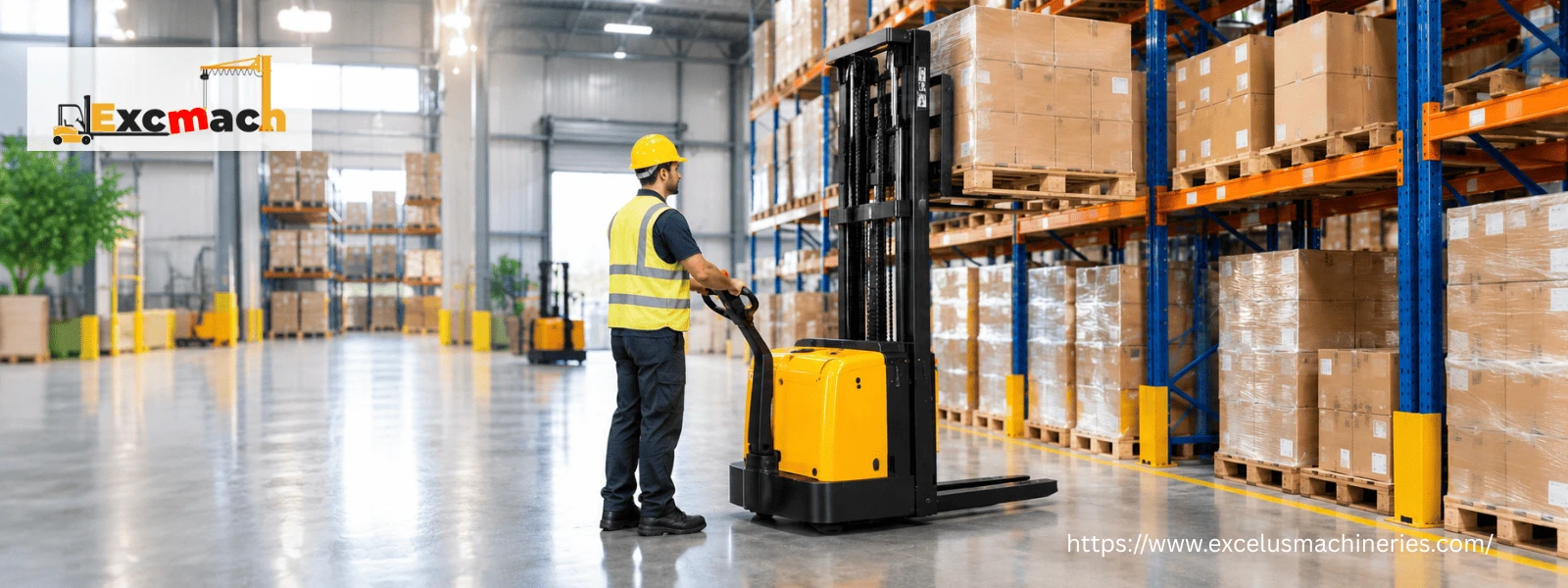
A warehouse team lifting 40kg drums by hand, stacking them three pallets high, and repeating that motion sixty times a shift is not a productivity problem you solve with more staff. It's a materials handling problem, and it usually points to one missing piece of equipment: a stacker machine.
As warehouses across manufacturing, food processing, chemicals, and logistics deal with tighter space, rising labor costs, and stricter safety expectations, stacker machines have moved from "nice to have" to a standard part of daily operations. This article looks at what a stacker machine actually does, where it earns its cost back, and what a business should weigh before buying one.
What Is a Stacker Machine Used For?
A stacker machine is designed to lift, move, and stack palletized or unitized loads to height, typically using a hydraulic or electric lifting mechanism paired with mobile forks or a platform. It can be useful for warehouse storage and retrieval, loading and unloading trucks, stacking raw material rolls or drums, and organizing inventory in racking systems where manual lifting is impractical.
Unlike a basic hand pallet truck, which moves loads horizontally at floor level, a stacker adds vertical lift. That single capability changes how a warehouse uses its space, because pallets can go up instead of only out.
Understanding Industrial Stackers: Manual vs. Hydraulic vs. Electric
Not all stacker machines work the same way, and the differences matter more than they first appear.
Manual stackers rely on a hand pump or hydraulic foot pump to raise the load, with the operator pushing the unit manually. They suit lower-frequency lifting tasks, tighter budgets, and facilities without stable power access on the floor.
Hydraulic stackers use a hydraulic cylinder for lifting but may still require manual movement or use a semi-electric drive. These are common in mid-volume operations for example, stacking paper rolls, drums, or packaged goods where lift height matters more than travel speed.
Fully electric stackers handle both lifting and travel electrically, reducing operator fatigue significantly. These fit high-frequency environments where the same lifting task happens dozens of times a day, such as distribution centers with continuous inbound and outbound pallet movement.
The right choice depends less on which type is "better" and more on how often the equipment will be used, what it will lift, and how the facility is laid out. A business handling paper rolls all day, for instance, has very different needs from one occasionally stacking packaged cartons.
Key Benefits of Using Stacker Machines in Warehouses
1. Better Use of Vertical Storage Space
Floor space in most warehouses is finite, but ceiling height often isn't fully used. A stacker lets a facility stack pallets two, three, or more levels high in racking, which increases storage density without expanding the building footprint. For businesses paying rent by the square foot, this is often the single biggest financial benefit.
2. Reduced Risk of Manual Handling Injuries
Manual lifting and stacking are among the more common causes of back injuries and strains in warehouse settings. A stacker machine takes the physical lifting load off the operator, which can lower the frequency of handling-related incidents and reduce the downtime and compensation costs that come with them. This matters most in facilities with repetitive lifting tasks food processing lines, drum handling in chemical storage, or high-turnover packaging warehouses.
3. Faster Load Movement and Pallet Turnaround
Stacking a pallet manually, or with a basic pallet truck and a ladder-based workaround, is slow and inconsistent. A stacker machine moves loads to height in a single controlled motion, which shortens the time between a pallet arriving and being put away or retrieved. In operations with tight dock schedules, that speed can directly affect how many trucks get processed per shift.
4. More Consistent, Controlled Lifting
Hydraulic and electric lifting mechanisms move loads at a controlled, even pace. This reduces the load-shifting and tipping risk that comes with manual stacking, especially with taller or narrower loads like drums, rolls, or stacked cartons. Consistency also matters for fragile or irregularly shaped goods, where uneven manual handling increases the chance of damage.
5. Lower Long-Term Labor Strain and Turnover
Warehouse roles involving constant manual lifting tend to see higher fatigue and turnover. Introducing a stacker machine can make physically demanding roles more sustainable for existing staff, which may reduce the recruitment and retraining cycle that comes with high-turnover manual roles.
6. Adaptability Across Industries
Stacker machines aren't limited to one type of warehouse. Manufacturing plants use them for staging components between production stages. Packaging and printing facilities often rely on a paper roll stacker to handle heavy rolls safely. Food processing facilities use stainless or food-grade variants for hygienic handling. Chemical and pharmaceutical operations use them for drum handling where controlled, careful lifting is essential. Logistics operations use them for rapid pallet turnaround during peak shipping periods.
Selection Factors: Choosing the Right Stacker Machine
Before selecting a stacker machine manufacturer or supplier, a few practical factors are worth weighing:
Load capacity – match the stacker's rated capacity to your heaviest routine load, not just your average one.
Lift height – measure your actual racking height requirements rather than estimating.
Frequency of use – a manual stacker may be sufficient for occasional lifting, while high-frequency operations typically justify an electric unit.
Floor conditions and aisle width – narrow aisles or uneven floors affect which stacker models are practical.
Load type – drums, rolls, and cartons often need different fork or platform configurations.
Power availability – electric stackers need consistent charging infrastructure on-site.
Maintenance access – consider whether your supplier offers ongoing service and spare parts locally, since downtime on lifting equipment can stall an entire pallet flow.
Businesses evaluating a material handling stacker for the first time often underestimate lift height needs and end up with a unit that can't reach the top rack level a costly mistake to correct after purchase. Working through these specifications with a supplier before ordering, such as by requesting a quote with your exact rack heights and load types, helps avoid this.
Operational Considerations for Implementation
Buying a stacker machine is only part of the process. A few operational details determine whether it actually improves throughput:
Operator training. Even a manual stacker requires basic operator training on load balancing and safe lifting height limits. Skipping this step increases tipping risk.
Aisle and turning radius planning. A stacker that can't turn comfortably in your existing aisle layout will slow operations rather than speed them up. It's worth measuring turning space before finalizing a model.
Battery and charging logistics (for electric units). Facilities running multiple shifts need a charging schedule that doesn't leave a stacker unavailable during peak hours.
Integration with existing racking. Rack beam heights and pallet sizes should be checked against the stacker's lift height and fork dimensions before purchase, not after delivery.
Common Mistakes When Choosing a Stacker Machine
Buying based on price alone, without checking load capacity against actual warehouse needs.
Overlooking lift height requirements, resulting in a stacker that can't reach top-level racking.
Ignoring floor and aisle conditions, which can make an otherwise suitable stacker impractical on-site.
Skipping operator training, increasing the risk of load imbalance or tipping.
Not confirming after-sales support, which becomes a problem the first time the unit needs servicing or spare parts.
Avoiding these mistakes generally comes down to involving warehouse staff in the selection process, since they understand daily load patterns better than a spec sheet does.
Where This Fits: Material Handling Stackers for Indian Warehouses
For warehouses across manufacturing, food processing, chemicals, logistics, and similar sectors, stacker machines are one of the more practical upgrades available for improving storage density and reducing manual handling risk. Excelus Machineries supplies a range of hydraulic stackers, including manual stackers suited to lower-frequency lifting and paper roll stackers designed for handling paper and film rolls in packaging and printing operations. Depending on load type and lifting frequency, these units can be paired with pallet trucks for a more complete floor-to-rack material handling workflow.
Businesses evaluating a stacker for their specific load types, lift heights, or facility layout can review the available options or reach out directly for guidance on matching a unit to their operation.
Final Takeaway
A stacker machine isn't just a lifting tool it's a way to reclaim vertical storage space, reduce manual handling injuries, and move pallets through a warehouse faster and more consistently. The benefit only shows up, though, when the machine is matched correctly to load capacity, lift height, aisle conditions, and usage frequency. Getting that selection right upfront saves far more in downtime and rework than it costs in initial evaluation time.
Recent Insights
View AllFrequently Asked Questions
A stacker machine is typically compact, designed for lower-capacity vertical lifting in tighter aisles, while a forklift generally handles heavier loads and offers greater mobility across open floor space. Stackers are often chosen for warehouses with narrower aisles or lower ceiling heights where a forklift would be impractical.