
5 Types of Stacker Machines for Efficient Material Handling
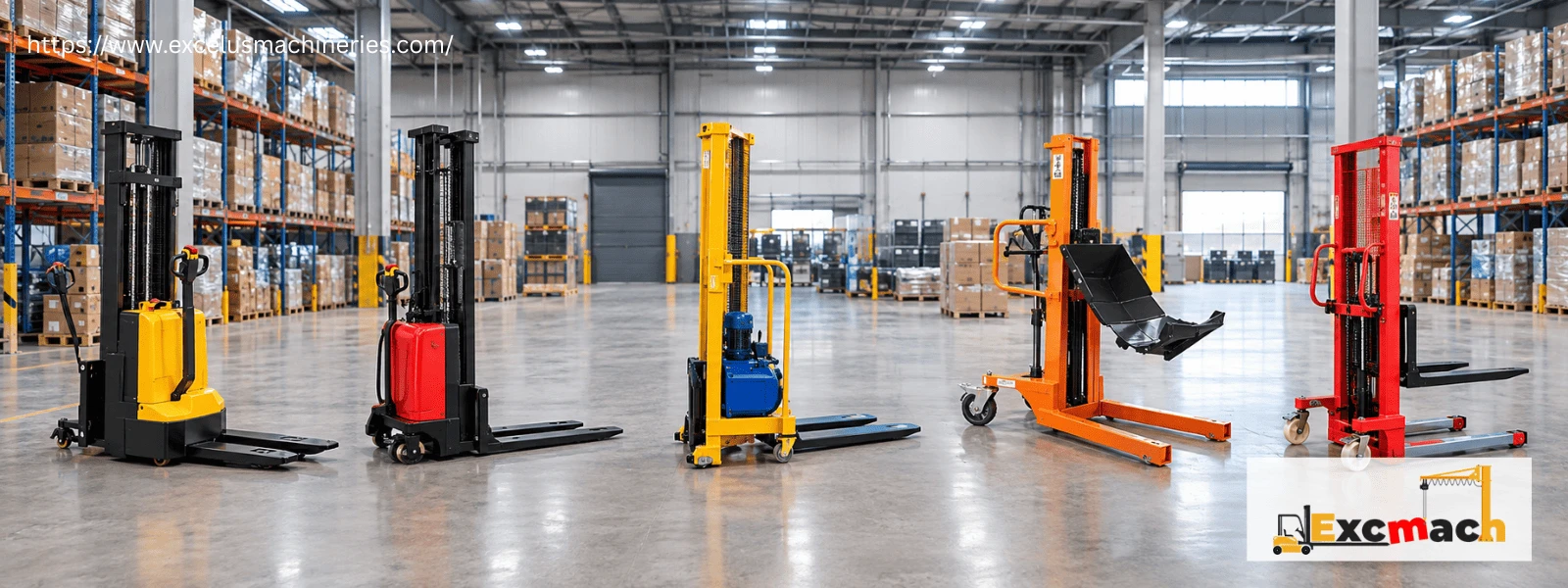
Not every stacker machine solves the same problem. Some are built for occasional, light lifting. Others are built to run almost non-stop through a shift. A few are shaped around loads that don't behave like a standard pallet at all, and even within the electric category, power supply setup can differ from one facility to another. Knowing the difference matters more than most buyers realize, since picking the wrong type usually means either overpaying for capability you don't need or watching your team struggle with equipment that can't keep pace.
This guide breaks down five types of stacker machines available from Excelus Machineries, what each one is actually built for, and where it tends to earn its cost. If you're researching material handling equipment for the first time, this should give you a clear starting point before comparing specific models.
Stacker Type | Lifting | Travel | Best Suited For |
Manual Stacker | Manual hydraulic | Manual | Occasional lifting |
Paper Roll Stacker | Application-specific | Manual | Paper rolls and cylindrical loads |
Semi-Electric Single/Three Phase | Electric | Manual | Regular lifting with available electrical supply |
Battery Operated Semi-Electric | Electric | Manual | Flexible warehouse movement |
Full Electric Stacker | Electric | Electric | Frequent lifting and travel |
1. Manual Stacker
A manual stacker is the simplest type on this list, and often the right choice for exactly that reason. The operator hand-pumps a hydraulic lever to raise the load and physically pushes the unit to move it no battery, no charging routine, nothing extra to maintain beyond the hydraulics themselves.
This makes a manual stacker a strong fit for lighter, occasional lifting: smaller retail backrooms, low-volume storage areas, or any operation where the equipment spends most of the day sitting idle between uses. The tradeoff is operator effort, which becomes a real limiting factor once lifting frequency or load weight climbs past "occasional." Excelus Machineries' manual stacker range covers this category directly.
2. Paper Roll Stacker
A paper roll stacker solves a problem general-purpose stackers aren't built for: handling cylindrical loads. Paper reels, textile rolls, film, and similar rolled materials don't sit stably on flat forks the load wants to shift or roll the moment it's lifted, and that risk only gets worse the higher it goes.
Instead of flat forks, this type uses a curved cradle or saddle attachment shaped to match the roll, distributing weight evenly along its length rather than concentrating it on two narrow points. Many models also let the operator rotate the roll into a specific orientation before setting it down, which matters for feeding rolls into presses or converting machinery correctly the first time. Excelus Machineries' paper roll stacker is built specifically around this cradle-and-rotation design, and it's a genuinely different decision from the electric-versus-manual question that applies to the other types here, since load shape is the deciding factor rather than power source.
3. Semi-Electric Stacker with Single/Three Phase
A semi-electric stacker takes the physical strain out of lifting while leaving travel to the operator. The lift runs through an electric-powered hydraulic system rather than a manually operated pump. The available electrical supply is an important consideration when selecting between single-phase and three-phase configurations, depending on the stacker's specifications and the electrical infrastructure at the operating location.
Facilities already wired for three-phase power on the shop floor may find this setup more efficient to integrate than relying purely on a standalone battery system, while single-phase compatibility covers more general electrical setups. Either way, the operator still walks the unit into position by hand, which keeps the equipment simpler and less costly to maintain than a fully powered travel system. Excelus Machineries' semi-electric stacker with single/three phase covers this configuration directly.
4. Semi-Electric Stacker (Battery Operated)
This type shares the same core idea as the previous one a powered lift with manual travel but draws from an onboard rechargeable battery instead of a direct electrical connection. That makes it a better fit for facilities that need the unit to move freely around the floor without staying tethered to a fixed power setup, or where three-phase power isn't readily available where the stacker is used.
Battery life and charge cycles vary by usage pattern, so it's worth thinking through how many lift cycles a shift actually involves before assuming any battery-operated unit will comfortably cover a full day. Excelus Machineries' battery-operated semi-electric stacker is built around this setup, and choosing between it and the single/three-phase version above usually comes down to how the facility is powered and how much the stacker needs to move around independently.
5. Full Electric Stacker
The four types above all leave travel to the operator in some form. A full electric stacker powers both the lift and the travel, so the operator controls raising, lowering, and driving through a tiller or control panel rather than physical effort in either direction.
This is the type worth the higher cost specifically in operations where the equipment barely stops moving long aisle runs, high lift-cycle counts, or a unit that gets handed between multiple operators across a shift. Buying this level of automation for light, occasional work is one of the more common overspending mistakes in material handling equipment purchasing, so it's worth being honest about actual usage first. Our guide to full electric stacker features and benefits goes deeper into exactly where that line sits.
How to Choose Between These Five Types
Matching the right type to your operation comes down to a handful of factors: how much you're lifting, how often, how far the equipment travels, whether your facility has three-phase power or relies on battery charging, and whether your loads are standard pallets or something irregular like rolls. We've laid out a full decision process in our guide on how to choose the right stacker for warehouse material handling, which walks through each of those factors in more depth than this overview can.
Common Mistakes When Comparing Stacker Types
Assuming a warehouse stacker from one category can substitute for another without checking load weight, lift height, and frequency is one of the most frequent and costly mistakes. Two units that look similar on a spec sheet can be built for very different jobs.
Choosing between the single/three-phase and battery-operated semi-electric configurations without checking the facility's actual power setup is a mistake specific to this category. The wrong choice here can mean either an inconvenient charging routine or an installation that doesn't match the available electrical supply.
Ignoring load shape until after a general-purpose unit is already on the floor is a mistake specific to operations handling rolls or similarly irregular materials flat forks and cylindrical loads don't combine well no matter how the lift is powered.
Skipping operator training because a stacker "seems simple" applies across every type on this list, not just the powered ones. Safe load positioning and pre-use checks matter regardless of how automated the equipment is, and the fundamentals covered in our stacker machine safety guidelines apply across every type discussed here.
Where Excelus Machineries Fits
Excelus Machineries is a Vapi-based material handling equipment supplier and hydraulic stacker manufacturer offering all five of these configurations directly, rather than a narrow slice of the category. That range matters because the right choice genuinely depends on details specific to your facility power supply, load shape, lift frequency not just a general sense of "manual versus electric."
For a broader look at why stacker machines earn their place in a warehouse to begin with, the general benefits of stacker machines is worth reading before comparing specific models.
Once you know roughly which type fits your load weight, power setup, and usage pattern, reach out to the team to confirm specifications for a specific model, or browse the full product range to compare directly.
Final Takeaway
The five stacker types covered here manual, paper roll, semi-electric with single/three phase, semi-electric battery operated, and full electric solve different combinations of load weight, usage frequency, load shape, and power setup. None of them is universally the right choice. The one that fits is whichever matches your actual operation, and Excelus Machineries offers all five directly rather than leaving that comparison to guesswork across different suppliers.
Recent Insights
View AllFrequently Asked Questions
The single/three-phase version runs on a direct electrical connection, while the battery-operated version draws from an onboard rechargeable battery. The right choice depends on your facility's power setup and how freely the unit needs to move without being tied to a fixed connection.