
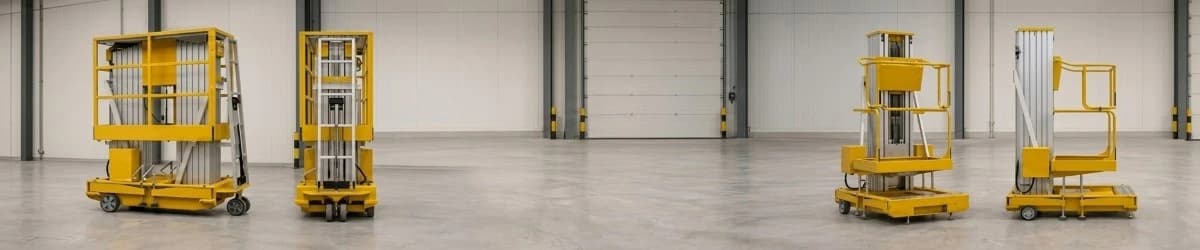
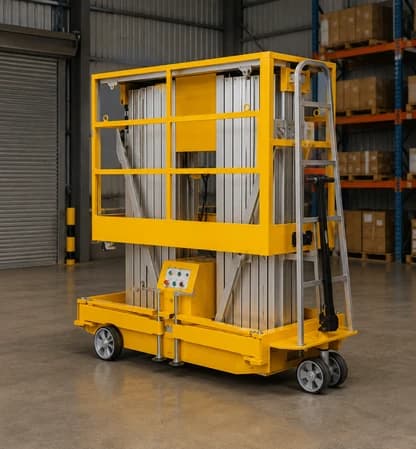
What is a Double Mast Single Phase / Battery Aerial Work Platform?
A Double Mast Single Phase / Battery Aerial Work Platform is a vertical personnel lifting machine designed to raise operators and tools to elevated working positions. It uses a double-mast structure with a lifting system that can be configured for single-phase electrical operation or battery-powered operation.
A Double Mast Single Phase Aerial Work Platform can be suitable for facilities where single-phase power is readily available, while a Double Mast Battery Operated Aerial Work Platform provides greater flexibility where independent battery operation is preferred.
This type of Electric Aerial Work Platform is commonly used for overhead maintenance, inspection, installation, electrical work, and facility servicing. The correct configuration depends on working height, platform capacity, operating environment, available power, and movement requirements.
Applications of Double Mast Single Phase / Battery Aerial Work Platform
A Double Mast Battery Operated Aerial Work Platform can support a wide range of elevated maintenance and access requirements.
Warehouse Maintenance – Supports overhead lighting, inspection, signage, and facility servicing.
Manufacturing Plants – Useful for machine maintenance, electrical servicing, inspections, and overhead installation.
Commercial Buildings – Assists with lighting, ceiling, signage, electrical, and facility maintenance.
Electrical Installation – Provides elevated access for suitable installation, inspection, and servicing activities.
Retail & Showrooms – Supports display installation, lighting maintenance, and signage work.
Facility Management – Helps personnel perform routine inspection and building maintenance tasks.
Industrial Service Areas – Useful for suitable overhead repair, inspection, and installation activities.
Industries Served
Manufacturing Industry – Supports overhead maintenance, inspection, and installation work.
Warehousing & Logistics – Provides elevated access for facility and warehouse maintenance.
Construction & Installation – Suitable for selected indoor installation and finishing activities.
Commercial Facilities – Supports ceiling, lighting, signage, and maintenance operations.
Electrical Industry – Helps provide controlled elevated access for suitable electrical tasks.
Facility Management – Supports inspection, repair, and routine maintenance activities.
Industrial Maintenance – Provides a practical solution for elevated servicing requirements.
How to Choose the Right Double Mast Aerial Work Platform
Selecting the right Double Mast Aerial Work Platform Manufacturer and configuration requires evaluation of the actual worksite and operating conditions.
Working Height – Select a platform height suitable for the intended task.
Platform Capacity – Consider the combined weight of the operator, tools, and materials.
Platform Dimensions – Ensure sufficient working area for the task.
Power Source – Choose single-phase or battery operation according to site requirements.
Charging Arrangement – For battery models, consider charging location and operating schedule.
Machine Dimensions – Check doorways, aisles, turning areas, and access routes.
Operating Surface – Ensure the floor is suitable for the selected equipment.
Movement Requirements – Consider how often and how far the platform needs to be repositioned.
Safety Features – Review guardrails, emergency stop, emergency lowering, braking, and applicable limit controls.
An experienced Double Mast Aerial Work Platform Supplier can help buyers evaluate these factors before selecting the equipment.
Technical Considerations
The performance of a Double Mast Single Phase / Battery Aerial Work Platform depends on working height, platform capacity, mast configuration, power source, floor conditions, machine dimensions, and operating practices.
Check Platform Capacity – Ensure the combined operator, tools, and material weight remains within the rated capacity.
Inspect Double Mast Structure – Check mast sections, guides, rollers, and lifting components for visible wear or damage.
Check Electrical System – Inspect cables, controls, connections, and applicable electrical components.
Monitor Battery System – For battery-operated models, check battery condition, terminals, charging system, and connections.
Verify Platform Stability – Operate the equipment only on a suitable and stable surface.
Inspect Guardrails and Access Gate – Ensure platform protection and access components are in suitable condition.
Check Wheels and Brakes – Inspect wheels and braking components before operation.
Check Emergency Functions – Verify applicable emergency stop and emergency lowering systems.
Observe Site Conditions – Consider overhead obstructions, floor condition, clearances, and surrounding traffic.
Follow Rated Limits – Do not exceed the manufacturer's specified operating limits.
Regular inspections and safe operating procedures help support reliable equipment performance.
Maintenance and Best Practices
Perform Regular Inspections – Check the mast, platform, wheels, brakes, lifting system, and controls before use.
Monitor Battery Condition – For battery-operated models, check battery charge, terminals, cables, and charging connections.
Inspect Electrical Components – Check switches, controls, wiring, and connections for damage or abnormal operation.
Check Hydraulic Components – Where applicable, inspect cylinders, hoses, fittings, and lifting components.
Inspect Mast Components – Check rollers, guides, chains, and mast sections for wear or damage.
Maintain Platform Safety Components – Inspect guardrails, access gates, emergency controls, and other safety provisions.
Keep Equipment Clean – Remove dust, grease, debris, and accumulated material.
Maintain Wheels and Brakes – Check wheel condition and braking performance regularly.
Avoid Overloading – Never exceed the platform's rated load capacity.
Train Operators – Ensure personnel understand correct lifting, lowering, positioning, and emergency procedures.
Follow Preventive Maintenance – Schedule maintenance according to the manufacturer's recommended program.
Why Choose Excelus Machineries?
Selecting a Double Mast Aerial Work Platform Manufacturer should involve more than comparing working height or purchase price. Businesses should evaluate platform capacity, power source, operating environment, safety provisions, dimensions, maintenance, and technical support.
Excelus Machineries provides industrial lifting solutions designed around practical workplace requirements.
Key advantages include:
Durable industrial construction
Application-focused aerial lifting solutions
Single-phase and battery-operated configuration options
Support for different working-height requirements
Technical assistance during equipment selection
Customization based on application requirements
Maintenance and operational guidance
Focus on controlled and reliable elevated access
For businesses looking for a Double Mast Aerial Work Platform Supplier, evaluating the complete work process and site conditions can help identify the most suitable configuration.
Conclusion
A Double Mast Single Phase / Battery Aerial Work Platform is a practical solution for businesses that require controlled vertical access for maintenance, installation, inspection, electrical, and facility-related work. Its double-mast structure provides vertical support, while single-phase or battery operation allows the equipment to be selected according to the available power source and application requirements.
Whether specified as a Battery Operated Aerial Lift, Double Mast Battery Operated Aerial Work Platform, Double Mast Single Phase Aerial Work Platform, or Electric Aerial Work Platform, selection should be based on working height, platform capacity, machine dimensions, power requirements, floor conditions, and operating environment.
As a Double Mast Aerial Work Platform Manufacturer and Double Mast Aerial Work Platform Supplier, Excelus Machineries provides industrial lifting solutions designed around practical operational needs, helping businesses improve elevated access, maintenance efficiency, and workplace organization.