
Paper Roll Stacker: Features, Applications & Selection Guide
Standard forks and paper rolls don't mix well. A cylindrical load sitting on flat forks has nowhere stable to rest, and any lateral shift during a lift can mean a dented roll, a damaged core, or worse, a load that slips off entirely. That's the exact problem a paper roll stacker is built to solve handling reels and cylindrical loads the way general-purpose stacking equipment simply isn't shaped to do.
This guide covers what a paper roll stacker actually is, the features that matter most, where it gets used across different industries, and what to check before choosing one. It's written for plant managers, procurement teams, and operations leads in paper, printing, packaging, and textile businesses evaluating dedicated paper roll handling equipment.
What a Paper Roll Stacker Is Best For
A paper roll stacker is purpose-built paper roll lifting equipment designed to cradle, lift, and stack cylindrical loads like paper reels, textile rolls, or film rolls without the risk of slippage or surface damage that comes from using standard fork attachments. It's the right choice whenever a facility regularly handles rolled or cylindrical materials rather than palletized boxes or cartons. For general palletized loads, a standard hydraulic stacker remains the more appropriate and cost-effective choice.
What Is a Paper Roll Stacker?
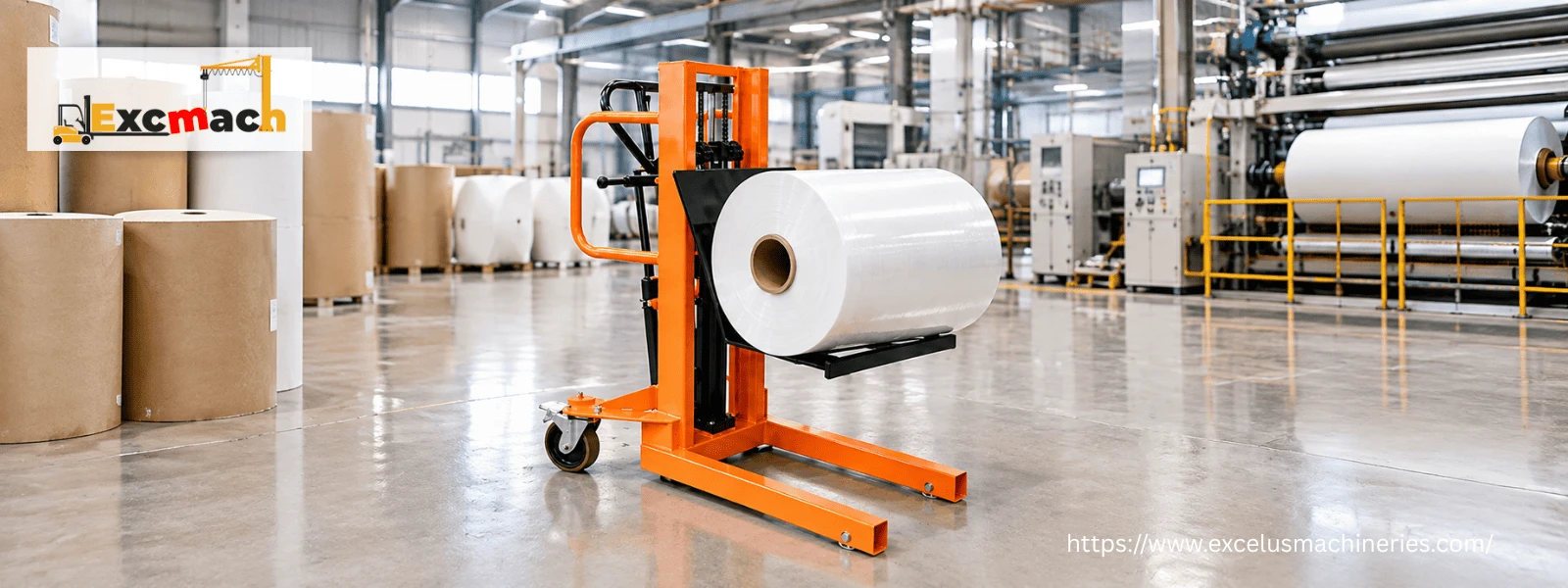
A paper roll stacker is a category of hydraulic stacker fitted with a cradle, saddle, or roll-clamp attachment instead of standard flat forks. The attachment is shaped to match the curve of a cylindrical load, distributing weight evenly along the roll rather than concentrating it on two narrow fork tines. This shape difference is the whole reason the equipment exists flat forks under a round load create instability that gets worse as lift height increases.
Most paper roll stackers also include some form of rotation capability, letting the operator turn the roll to a specific orientation before setting it down. That matters more than it might sound, since paper rolls are often loaded onto printing presses or converting machines in a specific orientation, and rotating the roll into position before it's set down is far safer and faster than trying to reposition it manually afterward.
Key Features of a Paper Roll Stacker
Cradle or saddle attachment: This is the defining feature a curved support structure that holds the roll securely along its length rather than gripping or piercing it. Attachment width and curve radius vary by model, so matching the attachment to the actual roll diameters in use matters more here than with standard pallet loads.
Hydraulic lift mechanism: Like other stackers in the hydraulic stacker family, lifting is handled through a hydraulic pump, either hand-operated or electric depending on the model. A hydraulic paper roll stacker gives smoother, more controlled lifting than trying to raise an oddly shaped, often heavy roll by other means.
Rotation function: Many models allow the cradle to rotate the roll a full 90 or 180 degrees, which helps when the roll needs to go from a horizontal storage position to a specific feed orientation on a machine.
Load capacity and roll diameter range: These two specifications matter together, not separately. A stacker rated for a certain weight might still be the wrong fit if the roll diameter exceeds what the cradle can securely hold, so both figures need checking against the actual materials being handled.
Stability features: Because cylindrical loads shift differently than boxed loads, stability design a wider base, controlled descent valves, secure clamping carries more weight in a paper roll stacker's design than it might in a general-purpose unit.
Benefits of Using a Paper Roll Stacker
Reduced product damage: A cradle attachment distributes weight evenly along the roll, cutting down on the crushing, denting, or core damage that can happen when cylindrical loads are handled with equipment that wasn't built for their shape.
Safer lifting and positioning: Rolls handled on flat forks or by hand carry a real risk of rolling or slipping mid-lift. A properly fitted cradle holds the load securely through the entire lift and lower cycle.
Faster changeovers on production lines: Rotation capability means a roll can be oriented correctly before it's set down, rather than requiring manual repositioning at the machine, which speeds up changeovers on presses and converting lines that go through rolls frequently.
Lower labor strain: Manually rolling, tilting, or repositioning heavy paper or textile rolls is physically demanding work. A stacker built for this shape of load removes most of that manual handling.
Better use of vertical storage: Rolls stored upright and stacked using a purpose-built stacker take up less floor space than rolls stored lying down, which matters in facilities where reel storage competes with production floor space.
Industrial Applications for Paper Roll Stackers
Paper mills and paper converting operations handle large reels constantly, moving them from storage to slitting, cutting, or converting equipment throughout the day, and this is the industry the equipment is most directly built around.
Printing facilities use paper roll stackers to load and unload rolls from web presses, where correct roll orientation directly affects how quickly a press can be changed over between jobs.
Packaging manufacturers working with film, foil, or laminate rolls face a similar handling challenge to paper, since these materials are also rolled and share the same instability problem on flat forks.
Textile mills handling fabric rolls or yarn beams deal with cylindrical loads that benefit from the same cradle-and-rotate approach, even though the material itself is different from paper.
Flexible packaging and label converting businesses working with smaller-diameter rolls still face the core problem this equipment solves, just at a different scale, which is why roll diameter range matters as much as raw load capacity when selecting a unit.
These use cases sit within the broader range of industries that rely on specialized material handling equipment, since the underlying challenge moving an oddly shaped or fragile load safely shows up well beyond paper alone.
Selection Factors for Choosing a Paper Roll Stacker
Roll diameter range. Confirm the cradle or saddle attachment actually accommodates the smallest and largest rolls the facility handles, not just an average size.
Load capacity. This needs to be checked against the heaviest rolls in regular use, with some margin, rather than assumed from a general product listing.
Rotation requirements. If rolls need to be fed into machinery at a specific orientation, rotation capability isn't optional it's worth confirming exactly how many degrees of rotation a given model supports.
Manual versus hydraulic lift. Lower-frequency operations may find a manual hydraulic pump sufficient, while facilities moving rolls constantly throughout a shift are more likely to benefit from an electric lift, similar to the tradeoff between a manual stacker and a powered one for standard pallet loads.
Aisle width and floor space. Paper roll stackers can have a different footprint than standard pallet stackers because of the cradle attachment, so it's worth measuring the actual unit against warehouse or production floor layout rather than assuming standard stacker dimensions apply.
Maintenance access. Hydraulic components and rotation mechanisms both need periodic servicing, so it's worth confirming what maintenance access looks like for a specific model before committing to it.
Common Mistakes When Choosing Paper Roll Handling Equipment
Assuming a standard fork stacker with an add-on attachment performs the same as purpose-built paper roll lifting equipment
Choosing based on load capacity alone without checking the roll diameter range the cradle can actually support
Overlooking rotation requirements until after the equipment is already in use on the production floor
Underestimating how much floor space a cradle-style stacker needs compared to a standard fork unit
Skipping operator training on the assumption that handling a round load is intuitive, when improper cradle positioning is a common cause of roll slippage
Where This Fits with Excelus Machineries
Excelus Machineries is a Vapi-based material handling equipment supplier, and paper roll handling is one of the areas where a dedicated, purpose-built stacker makes a genuine operational difference rather than being a marginal upgrade. The paper roll stacker range is built specifically around the cradle and rotation features covered above, rather than adapting a general-purpose unit to a job it wasn't designed for.
For operations also handling standard palletized loads alongside reels, the broader hydraulic stacker category covers manual and other configurations that may suit the rest of the facility's material handling needs.
When comparing a paper roll stacker manufacturer or paper roll stacker supplier, it's worth asking directly about roll diameter range, rotation degrees, and hydraulic maintenance requirements, since these vary meaningfully between brands and aren't always clear from a basic spec sheet. Get in touch with the team to talk through roll sizes and production line requirements, or browse the full product range to compare against other stacker configurations.
If paper rolls are only part of the operation, the benefits of stacker machines in general is a useful starting point for the rest of the equipment list.
Final Takeaway
A paper roll stacker solves a specific, physical problem that general-purpose stacking equipment isn't shaped to handle: safely lifting, holding, and positioning cylindrical loads without the instability or damage risk that comes from using flat forks. The right choice comes down to matching the cradle's diameter range and rotation capability to the actual rolls being handled, rather than assuming any hydraulic stacker with an attachment will do the job equally well.
Recent Insights
View AllFrequently Asked Questions
A purpose-built paper roll stacker is designed around the cradle or saddle mechanism from the ground up, including stability features suited to how cylindrical loads shift. A standard fork stacker fitted with an aftermarket attachment may work for light or occasional use, but often lacks the stability and rotation control a dedicated unit provides.