
Drum Handling Equipment: Types, Applications, Safety & Selection Guide
A filled industrial drum can weigh well over 200 kg, depending on its size, contents, and material density. Its cylindrical shape can also make it difficult to grip, move, tilt, or position safely. Attempting to move a heavy drum manually, or using equipment that is not designed for drum handling, can increase the risk of back injuries, dropped loads, spills, and equipment damage. Industrial drum handling equipment is designed to make these handling tasks safer, more controlled, and more efficient.
This guide explains the main types of drum handling equipment, their industrial applications, important safety considerations, and the factors to evaluate before selecting a suitable unit. It is intended for plant managers, warehouse supervisors, procurement teams, and material-handling professionals responsible for moving drums during daily operations.
What Counts as Drum Handling Equipment
Drum handling equipment is any drum handling machine or attachment built specifically to lift, tilt, rotate, or transport cylindrical drums safely, rather than relying on manual lifting or general-purpose material handling equipment not shaped for a drum's geometry. Excelus Machineries' drum equipment range spans this category from simple wheeled trolleys to powered drum lifting equipment capable of raising a loaded drum to height.
What ties these together is the drum's shape. A standard pallet truck or stacker is built around flat, boxed loads. A drum is round, often top-heavy when full, and needs to stay upright through every stage of handling. Equipment built for drums accounts for that directly, through supports, clamps, or cradles shaped to the drum rather than a generic flat surface.
Types of Drum Handling Equipment
Most drum handling needs fall into three functional groups: moving a drum across a floor, lifting or clamping it off the ground, and storing it securely between uses. Excelus Machineries' drum equipment range covers all three, with several configurations built for different drum counts, floor surfaces, and material finishes.
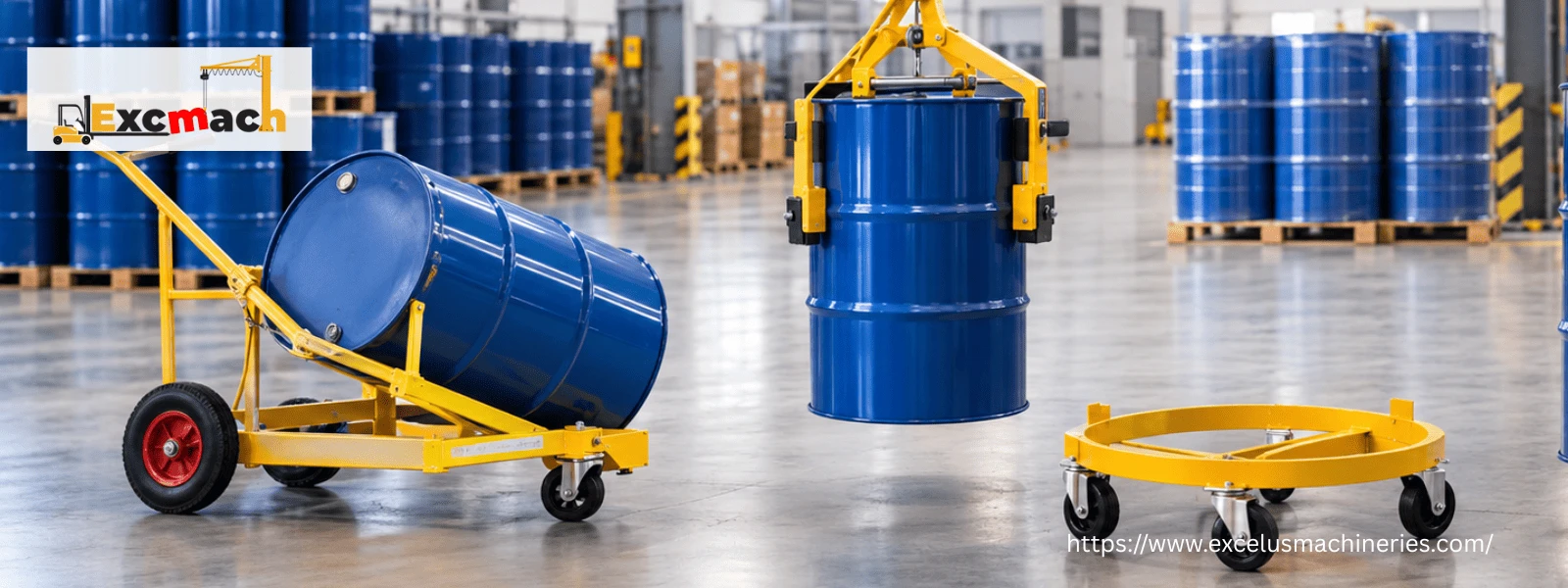
Transport equipment covers the trolleys and carts used to move a drum across a floor without lifting it to height. This group includes the SS Drum Trolley for stainless steel environments, the Drum Trolley – Nylon Wheel for standard floor transport, the Four Wheeler Drum Trolley for added stability with heavier loads, and the Drum Trolley with Scooter Wheel for easier maneuvering in tighter spaces. Drum Caddies and the Drum Truck fall into this same group, built for lighter-duty or single-drum movement rather than higher-capacity transport.
Lifting and clamping equipment covers units built to raise, grip, or reposition a drum rather than simply roll it. The SS Drum Handler and standard Drum Handler lift a drum off the floor for repositioning, the Drum Lifting Clamp grips the drum rim for crane- or hoist-assisted lifting, and the Drum Palletizer (Light/Heavy) is built specifically to load and unload drums at the corners of a pallet, available in configurations suited to different load weights. The full specifications for each of these sit within the same drum equipment catalog.
Storage and holding equipment covers units that keep drums secured in place rather than moving them. The Drum Stand for 2 Drums and Drum Stand for 3 Drums hold multiple drums upright and off the floor, which helps with dispensing, drainage, or simply keeping a storage area organized. Drum Handling Dollies offer a lighter, mobile version of the same idea for facilities that need to reposition stored drums occasionally rather than leave them fixed in one place.
Confirmed specifications lifting capacity, drum diameter compatibility, and wheel type vary across this range, so it's worth checking the specific listing for a given unit on the full product catalog rather than assuming capacity is uniform across the category.
Equipment Type | Main Function | Best For |
Drum Trolley | Floor-level transport | Short-distance movement |
Drum Handler | Lifting and positioning | Frequent drum handling |
Drum Lifting Clamp | Grip and lift | Crane/hoist applications |
Drum Palletizer | Pallet loading/unloading | Warehouse operations |
Drum Stand | Holding/storage | Fixed drum positioning |
Drum Caddy | Mobile drum support | Light-duty movement |
Industrial Applications for Drum Handling Equipment
Chemical and petrochemical facilities handle drums constantly, often containing hazardous or corrosive materials where a spill from mishandling carries real safety consequences beyond simple product loss.
Pharmaceutical and food processing operations move drums of raw materials and finished goods through production, where hygiene requirements and controlled handling both matter alongside the physical lifting itself.
Manufacturing plants using bulk liquids, lubricants, or powders rely on drum handling equipment to move supply from storage to the production line without manual lifting at any stage.
Logistics and warehousing operations storing and shipping drummed goods need equipment that can move drums efficiently between storage, loading docks, and transport, often across the same facility that also runs a hydraulic stacker for boxed and palletized goods the two equipment types solve different problems but frequently operate side by side.
Waste management and recycling facilities handle drums of varying condition and fill level, where stability during lifting matters even more given the unpredictable weight distribution of partially full or damaged containers.
Across Indian manufacturing, chemical, pharmaceutical, food processing, and warehouse operations, industrial drum handling equipment can help reduce manual handling and improve the controlled movement of loaded drums.
Safety Considerations in Drum Handling
A handful of risks come up repeatedly in drum handling, and Purpose-built drum handling equipment is designed to help address these risks:
Manual lifting injury — a drum's weight is concentrated low and off-balance compared to a box of similar size, which makes manual lifting of full drums one of the more common sources of back injury in facilities without proper equipment
Tipping during transport — a genuine concern with any drum moving equipment, particularly on uneven floors or ramps, which is why stable cradle design and appropriate wheel selection matter as much as raw lifting capacity
Chemical exposure risk — in facilities moving hazardous materials, a dropped or tipped drum doesn't just cause injury from the weight, it can also result in spillage requiring its own containment response
Insufficient operator training — knowing how to position a drum correctly, check equipment before use, and recognize an unstable load are basic safety steps that shouldn't be skipped just because drum handling feels more straightforward than operating a stacker or forklift
Selection Factors for Drum Handling Equipment
Five factors drive most decisions in this category, and skipping any one of them is usually what leads to a mismatch:
Drum weight — equipment needs to be rated for the maximum loaded weight you'll actually handle, not an average or empty-drum figure
Drum dimensions — diameter and height both need to be checked against a specific trolley, lifter, or clamp's compatible range, since this equipment is often sized for a particular range of drum sizes rather than a universal fit
Floor conditions — uneven surfaces, ramps, or outdoor areas call for different wheel and stability configurations than a flat, indoor warehouse floor
Operating frequency — occasional movement may only need a basic trolley, while frequent lifting across a shift justifies hydraulic or powered options, similar to the tradeoff between manual and powered stackers
Movement requirements — whether drums need to be lifted to height, rotated, or simply transported across a floor determines which category of equipment actually applies, since these functions aren't interchangeable
Common Mistakes When Choosing Drum Handling Equipment
Assuming any drum trolley fits any drum, without checking diameter and height compatibility, is one of the more frequent and avoidable mistakes.
Choosing equipment based on lifting capacity alone, without accounting for floor conditions or the stability needs of a partially full or unevenly weighted drum, can lead to tipping risk that a higher weight rating doesn't solve.
Treating drum handling as simple enough to skip training is a mistake that shows up disproportionately in injury reports, given how often back injuries trace back to manual lifting that equipment should have handled instead.
Overlooking the difference between transport equipment and lifting equipment leads some facilities to buy a trolley when the actual need was a hydraulic drum lifter, or vice versa, since the two solve different parts of the handling process.
Where Excelus Machineries Fits
The range includes drum trolleys, drum handlers, drum lifting clamps, drum palletizers, drum stands, and related solutions for different handling requirements. Product selection should be based on the required capacity, drum compatibility, lifting height, and operating environment.
Excelus Machineries is a Vapi-based material handling equipment supplier, working as both a drum handling equipment manufacturer and drum handling equipment supplier, with equipment built around the practical handling needs covered above.
Once you know your drum weight, dimensions, and how often they need to move, reach out to the team to confirm the right configuration, or browse the full product range to compare options directly.
Final Takeaway
Drum handling equipment exists to solve a problem that general-purpose material handling equipment isn't shaped for: moving a heavy, round, often top-heavy load safely and consistently. The right choice comes down to matching drum weight, dimensions, and the specific handling task transport, lifting, or rotation to equipment built for that function, rather than assuming any drum-rated machine covers every situation.
Recent Insights
View AllFrequently Asked Questions
A drum trolley moves a drum across a floor without lifting it to height, while a hydraulic drum lifter raises the drum vertically using a hydraulic pump. The right choice depends on whether your operation needs transport, lifting, or both.