What is an LPG & Oxygen Trolley?
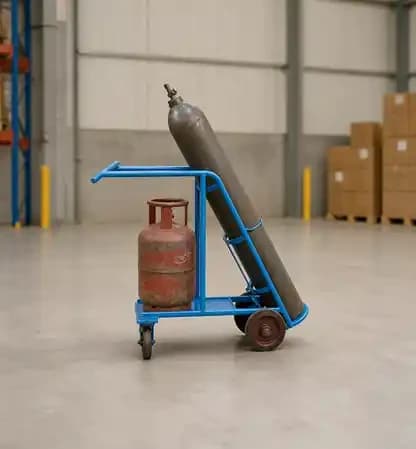
An LPG & Oxygen Trolley is a wheeled cylinder-handling unit designed to transport suitable gas cylinders manually. It generally consists of a supporting frame, cylinder holder or retaining arrangement, handles, axle, and wheels.
An Oxygen Gas Cylinder Trolley is designed to support compatible oxygen cylinders during movement, while an LPG Cylinder Hand Trolley can be used for suitable LPG cylinder transportation. The trolley should be selected according to the cylinder dimensions, filled cylinder weight, frame design, retaining arrangement, and manufacturer's specified capacity.
A Gas Cylinder Trolley is primarily a transport solution and should be used according to the cylinder manufacturer's handling requirements and applicable workplace safety procedures. The cylinder should remain properly restrained and stable during movement.
Applications of LPG & Oxygen Trolley
A Gas Cylinder Trolley can be used wherever compatible cylinders need to be manually transported over suitable short distances.
Industrial Gas Handling – Supports movement of compatible gas cylinders within industrial facilities.
Fabrication Workshops – Useful for handling suitable oxygen and other process-gas cylinders.
Automotive Workshops – Can support compatible cylinder transportation for workshop operations.
Maintenance Facilities – Helps move cylinders used in suitable maintenance and service activities.
Manufacturing Plants – Supports internal transportation of compatible cylinders between designated work areas.
Healthcare Facilities – Suitable oxygen-cylinder movement applications where the trolley meets site requirements.
Welding & Cutting Areas – Can support movement of compatible cylinders used for suitable fabrication processes.
Service & Utility Operations – Useful for designated cylinder transport and handling tasks.
An Oxygen Cylinder Trolley or LPG Cylinder Trolley should always be selected and used according to the cylinder manufacturer's requirements and applicable workplace procedures.
Industries Served
Manufacturing Industry – Supports designated gas-cylinder handling and internal transportation.
Metal Fabrication – Useful for moving compatible oxygen and process-gas cylinders.
Automotive Industry – Supports suitable workshop and maintenance cylinder handling.
Engineering Workshops – Helps transport compatible cylinders used in industrial operations.
Healthcare Facilities – Can support suitable oxygen-cylinder transport applications.
Industrial Maintenance – Useful for service and maintenance areas requiring cylinder movement.
Construction & Site Operations – Suitable for compatible cylinder handling where site procedures permit.
General Industrial Facilities – Supports organized movement of suitable gas cylinders.
How to Choose the Right LPG & Oxygen Trolley
Selecting the correct LPG & Oxygen Trolley requires consideration of the cylinder, load, operating environment, and transport route.
Cylinder Compatibility – Ensure the trolley is suitable for the cylinder type, diameter, height, and configuration.
Load Capacity – Select the trolley according to the filled cylinder weight and manufacturer's specified capacity.
Retaining Arrangement – Check that the cylinder can be adequately secured according to the trolley design and applicable handling procedure.
Wheel Configuration – Choose suitable wheel diameter and construction based on the floor and movement requirements.
Frame Construction – Ensure the frame is appropriate for the intended cylinder load and operating conditions.
Handle Design – Consider operator control and practical movement through the intended work area.
Ground Condition – Evaluate smooth floors, uneven areas, ramps, joints, and other travel conditions.
Movement Frequency – Select a suitable construction for occasional or repeated cylinder transport.
Operating Environment – Consider indoor, outdoor, wet, dusty, or industrial conditions.
Storage & Access Areas – Check that the trolley dimensions are suitable for doorways, aisles, and designated cylinder areas.
Manufacturer Specifications – Confirm load capacity, cylinder compatibility, dimensions, and operating recommendations before selection.
Businesses comparing an Oxygen Cylinder Trolley Supplier should evaluate cylinder compatibility and the complete handling requirement rather than selecting a trolley based only on frame size.
Technical Considerations
The performance of a Gas Cylinder Trolley depends on frame construction, cylinder compatibility, load capacity, wheel configuration, retaining arrangement, and operating practices.
Confirm the manufacturer's specified load capacity.
Check cylinder diameter and height compatibility.
Verify the retaining arrangement is suitable for the cylinder.
Ensure wheels and axles are properly mounted and rated for the intended load.
Inspect the frame for cracks, bends, deformation, or other structural damage.
Check handle construction and alignment.
Ensure the cylinder remains stable during movement.
Use the trolley only on suitable surfaces and within its intended application.
Avoid overloading or transporting incompatible cylinder sizes.
Follow applicable cylinder-handling procedures and manufacturer recommendations.
Keep the cylinder and trolley away from situations or conditions not permitted by the cylinder manufacturer or workplace procedures.
Inspect the complete trolley before regular use.
For gas-cylinder handling, the trolley should be considered part of the overall workplace handling system, and its design should remain compatible with the cylinders and site safety requirements.
Maintenance and Best Practices
Inspect Before Use – Check the frame, cylinder support, retaining arrangement, wheels, axle, handles, and mounting hardware.
Check Cylinder Support – Ensure the retaining components remain secure and functional.
Inspect Wheels – Check for excessive wear, cracks, wobbling, or restricted movement.
Check Axle & Mounting – Ensure wheel axles and related hardware remain properly secured.
Inspect Frame Condition – Look for bending, cracks, corrosion, or structural damage.
Keep the Trolley Clean – Remove dirt, oil, debris, and other contaminants that may affect movement.
Avoid Overloading – Never exceed the specified trolley capacity.
Maintain Stable Cylinder Positioning – Ensure the cylinder remains appropriately restrained during movement.
Check Handles – Make sure handles remain secure and suitable for controlled operation.
Monitor Wheel Movement – Watch for unusual noise, resistance, looseness, or instability.
Store Correctly – Keep the trolley in a suitable designated area when not in use.
Follow Preventive Maintenance – Inspect according to usage frequency and manufacturer recommendations.
Regular inspection and proper cylinder restraint can help maintain controlled movement and practical trolley performance.
Why Choose Excelus Machineries?
Selecting an LPG Cylinder Trolley Manufacturer requires consideration of cylinder dimensions, load capacity, frame construction, wheel arrangement, retaining design, operating environment, and product support.
Excelus Machineries provides industrial material handling and mobility solutions focused on practical application requirements. Cylinder trolley selection can be considered according to cylinder type, filled weight, work area, floor condition, movement frequency, and handling requirements.
Key considerations include:
Industrial Experience – More than two decades of experience in material handling solutions.
Application-Focused Selection – Trolley configuration is considered according to the actual cylinder-handling requirement.
Material Handling Expertise – Supports trolley, cart, wheel, and industrial handling applications.
Technical Guidance – Helps customers evaluate capacity, cylinder dimensions, wheel type, and operating conditions.
Customized Support – Suitable for application-specific cylinder handling requirements.
Quality-Focused Approach – Solutions are considered for practical industrial and commercial use.
After-Sales Support – Assistance for product-related and replacement requirements.
Industrial Customer Support – Suitable for procurement teams, engineers, maintenance personnel, and equipment users.
For businesses evaluating a Gas Cylinder Trolley Exporter or LPG Cylinder Trolley Manufacturer, important factors include cylinder compatibility, load capacity, retaining arrangement, wheel configuration, floor condition, and expected frequency of use.
Conclusion
An LPG & Oxygen Trolley provides a practical solution for moving compatible gas cylinders through factories, workshops, healthcare facilities, maintenance areas, fabrication units, and other designated work environments. Its supporting frame, retaining arrangement, handles, and wheels work together to provide controlled manual cylinder transportation.
Whether specified as a Gas Cylinder Trolley, Oxygen Cylinder Trolley, LPG Cylinder Trolley, Oxygen Gas Cylinder Trolley, Heavy Duty Cylinder Trolley, or LPG Cylinder Hand Trolley, the product should be selected according to cylinder dimensions, filled load, retaining requirements, wheel configuration, floor conditions, and manufacturer specifications. Excelus Machineries focuses on application-based material handling solutions for suitable industrial, commercial, and service requirements.