
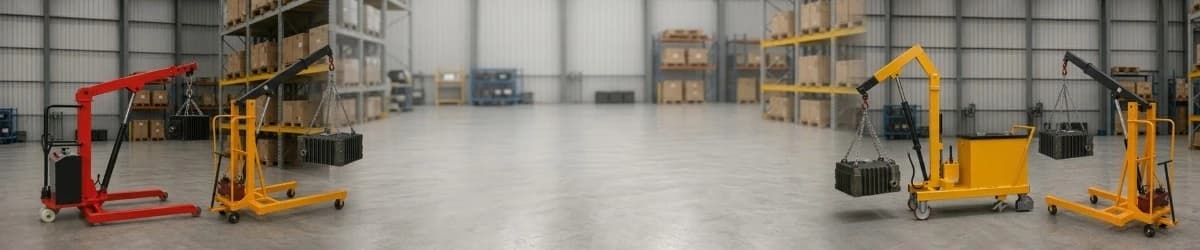
What is a Battery Operated Floor Crane?
A Battery Operated Floor Crane is a mobile industrial lifting crane powered by a rechargeable battery system. It is designed to lift and position suitable loads using electrically powered functions rather than relying entirely on manual operation.
A Fully Electric Floor Crane can provide powered lifting and other applicable operating functions, depending on the model. This can make it suitable for repetitive material handling tasks where reduced operator effort and controlled movement are important.
The actual lifting capacity, lifting height, boom reach, battery capacity, charging time, travel configuration, wheel arrangement, and operating controls vary by equipment model. These specifications should always be selected according to the manufacturer's specifications and the intended application.
Applications of Battery Operated Floor Crane
A Battery Operated Lifting Crane can be used for various industrial lifting and positioning applications where electrically assisted operation is preferred.
Manufacturing Plants – Supports handling of machinery parts, components, tooling, and assemblies.
Workshops – Helps lift and position engines, machine parts, tools, and other suitable loads.
Maintenance Departments – Assists with equipment servicing, component removal, and installation.
Warehouses – Supports selected lifting and positioning operations for heavy materials.
Automotive Facilities – Useful for suitable engine, transmission, component, and assembly handling.
Engineering Workshops – Helps position industrial components, fixtures, and machinery.
Machine Shops – Supports movement of dies, tooling, fixtures, and machine components.
Industrial Service Areas – Provides flexible lifting support for maintenance and handling activities.
Industries Served
Manufacturing Industry – Supports machinery and component handling.
Automotive Industry – Helps with lifting and positioning suitable vehicle components.
Engineering Industry – Suitable for industrial equipment and workshop applications.
Warehousing & Logistics – Supports selected material positioning tasks.
Machine Shops – Assists with tooling, dies, and industrial components.
Maintenance Facilities – Reduces physical effort during suitable servicing operations.
Industrial Workshops – Provides flexible electric floor-level lifting capability.
Fully Electric Battery Operated Floor Crane
A Fully Electric Battery Operated Floor Crane is designed for applications where electrically powered lifting and applicable movement functions are required. Unlike a manually operated crane, electric operation can help reduce physical effort and improve convenience during repetitive lifting and positioning tasks.
A Battery Operated Crane can be particularly useful in facilities where mobility, operator convenience, and flexible floor-level handling are important. Battery-powered operation can also be practical in locations where access to a continuous external power connection is limited, subject to the equipment configuration and duty cycle.
Important selection factors include:
Rated Lifting Capacity – Determine the maximum load that must be handled.
Load Centre – Consider the position of the load relative to the crane.
Lifting Height – Identify the required height for installation, maintenance, or positioning.
Boom Reach – Check the horizontal reach required to access the lifting point.
Battery Capacity – Match battery capacity to expected operating duration.
Charging Requirements – Evaluate available charging arrangements and charging time.
Travel Requirements – Determine whether powered movement is required and to what extent.
Load Dimensions – Consider the size, shape, and centre of gravity of the load.
Floor Conditions – Ensure the operating surface is appropriate for the crane.
Operating Frequency – Consider the expected number and duration of lifting cycles.
How to Choose the Right Battery Operated Floor Crane
Choosing the right Battery Operated Floor Crane requires evaluation of the load, lifting requirements, battery system, workspace, and operating environment.
Determine Load Capacity – Identify the maximum intended load under actual operating conditions.
Evaluate Load Centre – Consider how the load position affects the crane's working capacity.
Check Lifting Height – Select a configuration suitable for the required lifting range.
Confirm Boom Reach – Ensure the crane can access the required load position.
Review Battery Capacity – Match battery performance to the expected duty cycle.
Consider Charging Facilities – Ensure suitable charging arrangements are available.
Evaluate Powered Travel – Determine whether electrically powered movement is needed.
Check Floor Conditions – Verify that the crane can operate appropriately on the intended surface.
Assess Workspace – Review aisle width, turning space, and access around machinery.
Consider Load Type – Ensure the hook, sling, or other lifting attachment is appropriate.
Follow Manufacturer Specifications – Confirm capacity, electrical requirements, dimensions, operating limits, and maintenance requirements before purchase.
Businesses looking to select an Electric Material Handling Crane should evaluate the complete application rather than choosing equipment based only on lifting capacity.
Technical Considerations
The performance of an Electric Industrial Crane depends on rated capacity, load centre, boom reach, lifting height, battery system, hydraulic or electric lifting mechanism, wheel arrangement, floor condition, and operating practices.
Confirm the crane's rated capacity for the selected configuration.
Consider the load centre when determining the allowable working load.
Inspect the boom, frame, hook, and structural components before operation.
Check the battery, cables, terminals, connectors, and controls regularly.
Inspect charging equipment and follow the recommended charging procedure.
Check hydraulic components where the equipment incorporates a hydraulic lifting circuit.
Inspect wheels, casters, pins, fasteners, and other load-bearing components.
Ensure the load is correctly attached and balanced before lifting.
Avoid side pulling or operating outside the manufacturer's specified conditions.
Operate the crane only on an appropriate floor surface.
Keep personnel clear of suspended loads.
Do not exceed the rated capacity or operating limits.
Follow applicable workplace lifting procedures and manufacturer recommendations.
Regular inspection, operator training, battery care, and preventive maintenance are important for dependable crane performance.
Maintenance and Best Practices
Inspect Before Use – Check the frame, boom, hook, wheels, controls, and visible components.
Check Battery Condition – Inspect battery condition, terminals, cables, and connectors.
Follow Charging Practices – Charge the battery according to the manufacturer's recommended procedure.
Inspect Electrical Controls – Verify switches, controls, indicators, and other operating functions.
Check Hydraulic Components – Inspect cylinders, hoses, and fittings where applicable.
Inspect Lifting Accessories – Ensure hooks, slings, chains, and other accessories are suitable and properly rated.
Check Wheels & Casters – Inspect for excessive wear, damage, or movement issues.
Avoid Overloading – Never exceed the crane's rated lifting capacity.
Maintain Load Stability – Position and secure loads correctly before lifting.
Keep the Operating Area Clear – Remove obstacles that could interfere with crane movement.
Train Operators – Ensure users understand lifting, travel, positioning, and lowering procedures.
Schedule Preventive Maintenance – Service the crane according to usage and manufacturer recommendations.
Electric Lifting Crane
An Electric Lifting Crane provides powered lifting of suitable loads and can be beneficial for applications where repeated lifting operations create significant manual effort. Battery-powered versions offer additional flexibility for floor-level material handling.
The suitable electric configuration should be selected according to lifting capacity, load centre, lifting height, duty cycle, battery requirements, workspace, and operating environment. Electrical and battery components should be inspected and maintained according to the manufacturer's recommendations.
Why Choose Excelus Machineries?
Selecting a Floor Crane Manufacturer or Floor Crane Supplier requires attention to lifting capacity, battery performance, construction, operating configuration, application suitability, and technical support.
Excelus Machineries provides industrial material handling and lifting solutions focused on practical application requirements. Equipment selection can be aligned with load handling needs, workspace conditions, operating frequency, and suitable lifting configuration.
Key advantages include:
Industrial material handling expertise
Electric and battery-powered lifting solutions
Application-focused equipment selection
Support for different load-handling requirements
Practical solutions for workshops, factories, and warehouses
Customization support for suitable applications
Technical guidance during product selection
Maintenance and operational guidance
For businesses looking for an Electric Floor Crane Manufacturer or battery-powered lifting solution, the final selection should consider rated capacity, load centre, lifting height, boom reach, battery capacity, charging requirements, floor conditions, and frequency of operation.
Conclusion
A Battery Operated Floor Crane provides a flexible solution for electrically powered lifting and positioning of suitable industrial loads in workshops, warehouses, factories, maintenance facilities, and engineering environments. A Fully Electric Floor Crane can reduce manual effort during repetitive handling tasks, while battery-powered operation supports convenient floor-level mobility without continuous external power connection, depending on the configuration.
Whether used as a Battery Operated Crane, Battery Operated Lifting Crane, Electric Lifting Crane, or Fully Electric Battery Operated Floor Crane, the equipment should be selected according to rated capacity, load centre, lifting height, boom reach, battery requirements, operating frequency, and workspace conditions. Excelus Machineries provides industrial lifting and material handling solutions designed around practical operational requirements, helping businesses improve handling efficiency and workflow flexibility.