What is a Chain Pulley Block?
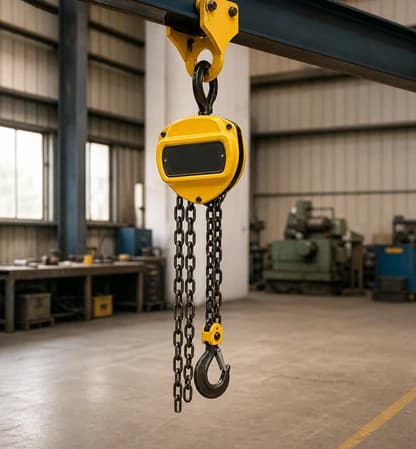
A Chain Pulley Block is a mechanical lifting device that uses a hand chain, load chain, gears, and lifting components to raise or lower a suspended load. The operator pulls the hand chain, which drives the internal mechanism and transfers lifting force to the load chain.
A Manual Chain Pulley Block is commonly used for lifting machinery, components, fabrication assemblies, tools, and other suitable loads in industrial environments. Because it does not depend on electricity, it can be used in locations where a manual lifting system is more convenient.
A Hand Operated Chain Pulley Block is particularly useful for maintenance, installation, repair, and workshop applications where controlled vertical movement is required.
Applications of Chain Pulley Block
A Chain Hoist is widely used wherever controlled manual lifting of suitable loads is required.
Manufacturing Industry – Lifting machinery, components, assemblies, and production equipment.
Engineering Workshops – Handling fabricated structures, machine parts, and maintenance components.
Construction Sites – Supporting suitable lifting tasks during installation and assembly work.
Warehousing – Moving equipment, tools, machinery parts, and other heavy components.
Automotive Industry – Lifting engines, machine components, fixtures, and maintenance assemblies.
Maintenance Facilities – Assisting with repair, servicing, installation, and equipment positioning.
Fabrication Industry – Handling fabricated structures and components during workshop operations.
Industries Served
Manufacturing Plants – Supports machinery handling, maintenance, and installation.
Engineering & Fabrication – Helps lift and position components and fabricated assemblies.
Construction Industry – Supports suitable equipment and component lifting applications.
Automotive Industry – Used for handling engines, machinery, tools, and components.
Warehousing & Logistics – Assists with lifting equipment and heavy materials.
Plant Maintenance – Supports repair, installation, and equipment servicing operations.
Industrial Workshops – Provides practical manual lifting for repetitive workshop tasks.
How to Choose the Right Chain Pulley Block
Selecting the right Chain Pulley Hoist requires evaluation of the load, lifting environment, available support structure, and frequency of use.
Load Capacity – Choose a block according to the maximum load to be lifted.
Lift Height – Determine the required vertical lifting distance.
Application Type – Consider whether it will be used for maintenance, installation, fabrication, or material handling.
Supporting Structure – Verify that the beam, trolley, hook, or other support can safely accommodate the lifting arrangement.
Operating Frequency – Select equipment suitable for the expected frequency of manual lifting.
Load Characteristics – Consider the size, shape, centre of gravity, and lifting points of the load.
Operating Environment – Evaluate dust, moisture, temperature, and other workplace conditions.
Hook Configuration – Ensure the hook arrangement is suitable for the lifting application.
Safety Requirements – Review applicable load-control and lifting procedures before operation.
For demanding applications, a Heavy Duty Chain Block should be selected according to the actual load and duty requirements.
Technical Considerations
The performance of a Chain Pulley Block depends on rated capacity, lifting height, chain condition, support structure, load stability, and correct operating practices.
Check Rated Capacity – Ensure the load remains within the manufacturer's specified capacity.
Inspect Load Chain – Check for wear, deformation, corrosion, or damaged links.
Inspect Hooks – Check hooks, latches, and attachment points before lifting.
Check Hand Chain – Ensure the hand chain operates smoothly without damage or obstruction.
Inspect Gearing Mechanism – Check gears and internal lifting components according to maintenance requirements.
Verify Support Structure – Ensure the supporting beam, trolley, or lifting point is suitable for the intended load.
Maintain Load Stability – Ensure the load is correctly attached and balanced before lifting.
Avoid Side Loading – Use the lifting device according to its intended vertical lifting configuration.
Follow Rated Limits – Never overload the chain hoist or use damaged components.
Train Operators – Ensure personnel understand correct lifting, lowering, inspection, and safety procedures.
Regular inspection and correct handling practices help maintain dependable performance and support safer lifting operations.
Maintenance and Best Practices
Inspect Before Use – Check the body, hooks, chains, gears, and attachment points before operation.
Check Load Chain – Inspect the chain for wear, elongation, corrosion, deformation, or damaged links.
Inspect Hooks – Check hooks and safety latches for damage or abnormal deformation.
Maintain Hand Chain – Ensure smooth operation and inspect for damaged or obstructed links.
Lubricate Applicable Components – Follow the manufacturer's recommended lubrication schedule.
Check Gears and Mechanism – Inspect the lifting mechanism for abnormal noise, wear, or irregular operation.
Avoid Overloading – Never exceed the rated capacity of the Manual Chain Pulley Block.
Verify Supporting Structure – Check the beam, trolley, or suspension point before lifting.
Keep Equipment Clean – Remove dust, grease, debris, and contaminants from accessible components.
Train Operators – Ensure operators follow correct lifting and load-handling procedures.
Follow Preventive Maintenance – Schedule inspections and servicing according to manufacturer recommendations.
Why Choose Excelus Machineries?
Selecting a Chain Pulley Block Manufacturer involves more than comparing lifting capacity and price. Businesses should evaluate equipment construction, application suitability, lifting requirements, maintenance, technical guidance, and long-term support.
Excelus Machineries provides industrial lifting and material handling solutions designed around practical operational requirements.
Key advantages include:
Durable industrial construction
Manual lifting solutions for industrial applications
Application-focused equipment selection
Suitable configurations for different lifting requirements
Technical assistance during product selection
Customization support for specific applications
Maintenance and operational guidance
Focus on reliable industrial material handling
For businesses looking for a Chain Hoist Supplier, evaluating load capacity, lift height, supporting structure, operating environment, and expected usage helps identify the appropriate lifting solution.
Conclusion
A Chain Pulley Block is a practical manual lifting solution for factories, workshops, construction sites, warehouses, maintenance facilities, engineering units, and other industrial environments. Its hand-operated mechanism provides controlled vertical lifting without requiring an external electrical power source.
Whether specified as a Chain Block, Chain Hoist, Manual Chain Hoist, Manual Chain Pulley Block, or Heavy Duty Chain Block, the equipment should be selected according to load capacity, lift height, supporting structure, load characteristics, operating frequency, and workplace conditions.
As a Chain Pulley Block Manufacturer and Chain Hoist Supplier, Excelus Machineries provides industrial lifting solutions designed around practical application requirements, helping businesses achieve controlled load handling, dependable operation, and efficient material movement.