
Stacker Machine: Types, Features, Uses & Benefits
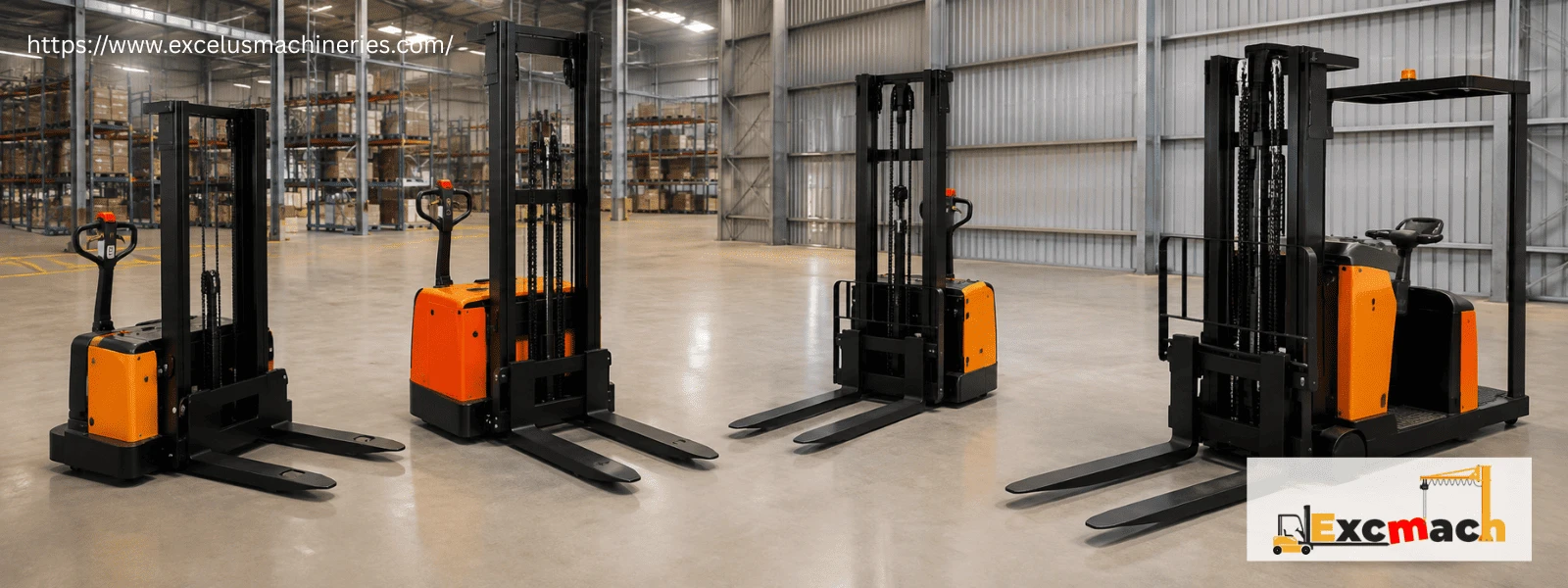
A Stacker Machine is material handling equipment used to lift, move, position, and stack pallets or other industrial loads at different heights. It is commonly used in warehouses, manufacturing plants, logistics facilities, packaging units, and other workplaces where materials need to be moved vertically and organized efficiently.
Unlike equipment designed mainly for long-distance transportation, stackers are particularly useful when the job involves lifting and placing loads at elevated levels. Depending on the application, businesses can choose from manual, semi-electric, full-electric, or specialized stacker configurations.
Excelus Machineries provides industrial lifting and material-handling solutions, including Hydraulic Stacker equipment. Its listed stacker range includes solutions such as Manual Stacker and Paper Roll Stacker, while its material-handling portfolio also includes other lifting and pallet-handling equipment.
What Does a Stacker Machine Do?
A Stacker Machine is material handling equipment used to lift, move, position, and stack pallets or other industrial loads at different heights. Depending on the model, it may use manual hydraulic, battery-operated, or electric lifting and travel systems.
What Is a Stacker Machine?
A stacker combines a lifting mechanism with forks or another suitable load-supporting attachment to raise materials from floor level and position them at the required height.
A typical industrial stacker may include:
Mast and lifting structure
Forks or specialized load support
Hydraulic or electric lifting system
Wheels and steering mechanism
Operating controls
Load-supporting frame
The operating method varies by machine. A manual hydraulic stacker relies on operator-powered hydraulic lifting, while powered configurations use battery or electrical systems for some or all operating functions.
Stackers can be useful for:
Pallet lifting and positioning
Vertical storage
Material movement within a facility
Production-area handling
Warehouse storage and retrieval
Specialized load handling
The main advantage is simple: a stacker allows businesses to use vertical space while reducing the physical effort involved in lifting materials manually.
How Does a Stacker Machine Work?
Although operating methods vary between models, the basic handling sequence is straightforward:
Position the forks correctly under the pallet or load.
Check that the load is stable and properly distributed.
Lift the load using the machine's hydraulic or powered mechanism.
Move the load carefully to the required location.
Position it at the required storage or working height.
Lower the load in a controlled manner.
Remove the forks after confirming the load is safely positioned.
Operators should work within the machine's rated capacity and follow the manufacturer's operating instructions and workplace safety procedures.
Types of Stacker Machines
Different applications require different levels of lifting assistance, maneuverability, and specialization. Excelus Machineries' material-handling offering includes Hydraulic Stacker solutions, with Manual Stacker and Paper Roll Stacker products currently listed on its website.
1. Manual Stacker
A Manual Stacker is a hydraulic lifting solution designed for lifting, stacking, and moving palletized goods without requiring electric travel or powered lifting.
It can be a practical choice where material handling is moderate, the operating environment is relatively controlled, and businesses prefer a straightforward machine without battery charging requirements.
Excelus Machineries lists its Manual Stacker with Economy Model 1 Ton and Heavy Model 2 Ton variations, subject to the specifications of the selected model.
Benefits of a Manual Stacker
Hydraulic lifting operation
No battery charging requirement
Relatively simple operation
Practical for moderate material handling
Suitable for warehouses and industrial workspaces
Lower dependence on powered systems
Manual stackers are particularly useful when powered travel is unnecessary but lifting loads above floor level is still required.
2. Semi Electric Stacker – Battery Operated
A Semi Electric Stacker Battery Operated combines manual movement with powered lifting assistance. It can reduce operator effort during repetitive lifting tasks while retaining a relatively simple handling arrangement.
This configuration can be useful in warehouses, manufacturing facilities, packaging areas, and other operations where loads are lifted regularly but full electric travel may not be necessary.
When selecting a battery-operated semi-electric stacker, consider:
Maximum load
Required lifting height
Battery capacity
Daily operating cycles
Charging arrangements
Available maneuvering space
3. Semi Electric Stacker – Single / Three Phase
A Semi Electric Stacker with Single / Three Phase is intended for applications where the available electrical infrastructure forms part of the equipment selection process.
The appropriate configuration depends on the machine specification and the electrical supply available at the facility. Before purchase, buyers should verify voltage, phase requirements, installation conditions, and operating requirements with the supplier.
This type of stacker can be considered for industrial workshops, manufacturing plants, warehouses, and other facilities requiring powered lifting assistance.
4. Full Electric Stacker
A Full Electric Stacker uses electric power for major operating functions such as lifting and travel. It can be suitable for workplaces where pallet handling is frequent and reducing manual effort is a priority.
Powered movement can be especially useful in applications involving repetitive pallet transportation and positioning.
When evaluating a full-electric stacker, businesses should consider:
Load capacity
Lifting height
Battery runtime
Charging time and infrastructure
Aisle width
Travel distance
Operating frequency
Floor conditions
The goal is not simply to select the most powerful machine, but to select one that matches the actual material-flow requirements.
5. Paper Roll Stacker
A Paper Roll Stacker is a specialized material-handling solution for paper rolls and other cylindrical loads.
Unlike standard palletized materials, rolls can behave differently during lifting and movement because their shape can affect stability and positioning. A dedicated roll-handling solution can therefore be more appropriate for industries where cylindrical loads are handled regularly.
Excelus Machineries lists a Paper Roll Stacker under its Hydraulic Stacker category.
Typical Applications
Paper manufacturing
Printing facilities
Packaging operations
Paper storage
Roll-handling areas
Businesses should evaluate roll diameter, roll weight, storage height, support requirements, and facility layout before selecting equipment.
Key Features to Consider in an Industrial Stacker Machine
Selecting an Industrial Stacker Machine requires more than checking the maximum lifting capacity. The equipment needs to match the complete working environment.
Load Capacity
Determine the typical and maximum load weights before purchasing. Load dimensions, load center, and weight distribution can also influence the suitability of the machine.
Never assume that a machine's maximum rated capacity applies equally to every lifting condition. Always refer to the specific manufacturer's specifications.
Lifting Height
The required lifting height should match the actual storage or working location.
Consider:
Rack height
Pallet height
Ceiling clearance
Required stacking level
Mast configuration
Fork Size and Load Compatibility
Fork length, width, spacing, and configuration should be compatible with the pallets or materials being handled.
Specialized loads may require a purpose-designed attachment or support arrangement.
Maneuverability
A stacker must be able to operate comfortably within the facility.
Measure:
Aisle width
Turning areas
Doorways
Floor conditions
Ramps
Storage layout
Working clearances
A machine that meets the lifting requirement but cannot maneuver effectively may create operational problems.
Power and Operating Requirements
For electric and semi-electric machines, battery capacity and electrical infrastructure are important considerations.
Review the equipment's expected operating cycle and ensure the selected power system is appropriate for daily usage.
Stability and Safety
Safe operation depends on more than the machine itself. Correct load positioning, rated capacity, operator training, routine inspection, and appropriate operating procedures all contribute to safe material handling.
Benefits of Using a Stacker Machine
A properly selected Material Handling Stacker can improve the way goods are lifted, positioned, and stored.
Better Use of Vertical Space
Stackers allow materials to be stored above floor level, helping warehouses make better use of available vertical space.
Reduced Physical Handling
Mechanical lifting reduces the need for workers to manually raise heavy loads, particularly during repetitive tasks.
More Organized Material Flow
Stackers can support the movement of goods between receiving, storage, production, packaging, and dispatch areas.
Flexible Equipment Selection
Businesses can choose between manual and powered configurations depending on workload, handling frequency, and infrastructure.
Suitable for Specialized Applications
Standard pallet handling is not the only use case. Specialized equipment such as Paper Roll Stackers can address specific industrial load requirements.
Practical Industrial Solution
A stacker can fill the gap between basic manual handling and larger material-handling equipment when the primary requirement is controlled lifting and positioning.
Applications of a Warehouse Stacker Machine
A Warehouse Stacker Machine can support a range of material-handling tasks across industrial environments.
Warehousing and Distribution
Stackers can assist with pallet storage, positioning, retrieval, and movement within warehouse areas.
Manufacturing
Manufacturing facilities can use suitable stackers for raw materials, components, packaging supplies, work-in-progress materials, and finished goods.
Logistics
Logistics operations can use stackers to organize pallet movement across storage and dispatch areas.
Packaging
Packaging facilities may require lifting equipment for pallets, packaging materials, or specialized loads moving between production and storage.
Paper and Printing
Specialized roll-handling solutions can support facilities working with large paper rolls and other cylindrical materials.
Industrial Workshops
Engineering units and industrial workspaces can use suitable stackers for lifting and positioning heavy or palletized materials.
How to Choose the Right Stacker Machine
The right Stacker Machine should be selected based on the application rather than price or lifting capacity alone.
1. Identify the Load
Record the typical and maximum load weight, dimensions, center of gravity, and pallet type.
2. Determine the Required Lifting Height
Measure the highest position where the load must be placed and account for rack and ceiling clearances.
3. Assess Handling Frequency
Occasional handling may be well suited to a manual solution, while repetitive operations may justify semi-electric or full-electric equipment.
4. Measure the Working Area
Check aisle width, turning radius, floor condition, doorways, ramps, and other restrictions.
5. Check Power Availability
For powered equipment, verify battery requirements or the electrical supply available at the facility.
6. Match Equipment to the Material
Standard pallets and cylindrical paper rolls have different handling requirements. Use a specialized solution where the load demands one.
7. Evaluate the Manufacturer and Supplier
When choosing a Stacker Machine Manufacturer or Industrial Stacker supplier, look beyond the initial price.
Consider:
Product specifications
Engineering experience
Customization capability
Technical assistance
Spare-parts availability
After-sales support
Application-specific guidance
Common Mistakes to Avoid When Buying a Stacker
Choosing only by price
A lower purchase price does not automatically make a machine the right fit. Consider productivity, maintenance, service support, and application suitability.
Ignoring the load center
Two loads with the same weight can behave differently depending on their dimensions and center of gravity.
Overlooking available space
Always verify aisle width, turning space, and access points before selecting equipment.
Assuming maximum capacity is universal
Rated capacity can be affected by lifting configuration and load characteristics. Use the manufacturer's specifications as the primary reference.
Selecting the wrong power configuration
Battery-powered and electrically powered models have different infrastructure and operating requirements.
Ignoring maintenance
Routine inspection of hydraulic systems, wheels, forks, frame components, controls, and other critical parts helps support reliable operation.
Why Choose Excelus Machineries?
When investing in a Stacker Machine, choosing a reliable manufacturer is as important as selecting the right equipment. Excelus Machineries provides material handling and lifting solutions designed to meet the operational needs of warehouses, manufacturing facilities, and industrial workplaces.
Businesses choose Excelus Machineries because of its commitment to:
High-quality material handling and lifting equipment
Application-focused stacker machine solutions
Reliable equipment for different industrial requirements
Industry-focused engineering and manufacturing expertise
Technical guidance for selecting suitable equipment
Customized solutions for specific handling applications
Quality-focused products designed for reliable performance
Support for warehousing, logistics, manufacturing, and other industries
Whether your operation requires a Manual Stacker, Hydraulic Stacker, or specialized material handling solution, Excelus Machineries helps businesses identify equipment based on their load, lifting height, workspace, and operational requirements.
Key Takeaways
A Stacker Machine is primarily used for lifting, positioning, and stacking materials at different heights.
Manual stackers are suitable for straightforward hydraulic lifting applications.
Semi-electric models provide powered lifting assistance for applications requiring reduced manual effort.
Full-electric stackers can support frequent powered lifting and travel.
Paper Roll Stackers are designed for specialized cylindrical loads such as paper rolls.
Load capacity, lifting height, load center, aisle width, power requirements, and operating frequency should all be considered before purchasing.
The right Stacker Machine Manufacturer should provide appropriate specifications, technical guidance, service support, and application-based solutions.
Conclusion
A Stacker Machine can make a significant difference in warehouse and industrial material handling by providing controlled lifting and vertical positioning of pallets and other loads. The right configuration can help reduce manual lifting, organize storage, and support smoother movement of materials between different areas of a facility.
Manual, semi-electric, full-electric, and specialized stackers each serve different operational needs. Choosing between them should be based on the load, required lifting height, handling frequency, available space, power infrastructure, and type of material being handled.
For businesses comparing Stacker Machine Manufacturers or Industrial Stacker suppliers, equipment quality is only one part of the decision. Technical guidance, customization capability, service support, spare parts, and long-term application suitability are equally important.
With its focus on industrial lifting and material-handling solutions, Excelus Machineries offers equipment for businesses looking to improve lifting, stacking, and internal material movement.
Recent Insights
View AllFrequently Asked Questions
A Stacker Machine is material handling equipment used to lift, move, position, and stack pallets or other loads at different heights. Depending on the model, lifting can be manual, hydraulic, battery-assisted, or fully electric.