
Rough Terrain Pallet Truck: Complete Guide to Features, Applications & Benefits
Moving palletized materials becomes challenging when conventional warehouse equipment has to operate beyond smooth indoor floors. Construction sites, agricultural facilities, industrial yards, gravel surfaces, outdoor warehouses, and loading areas can present uneven ground, dirt, mud, grass, and other demanding conditions.
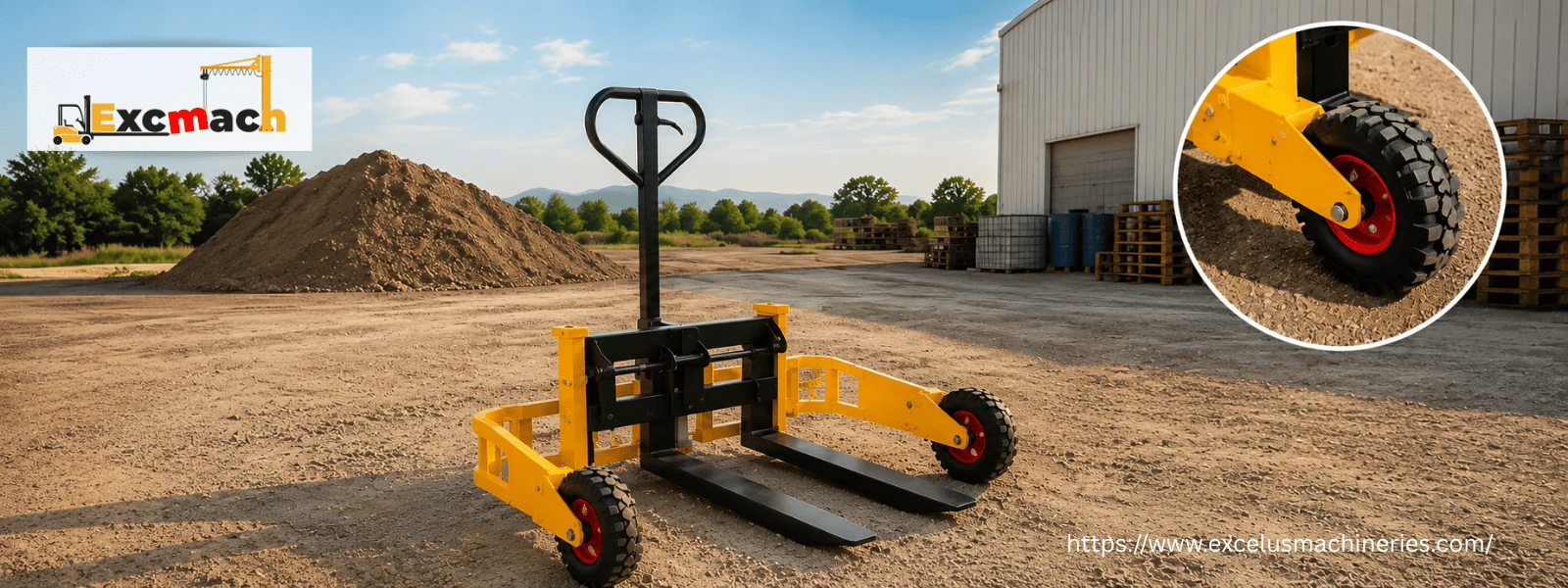
A Rough Terrain Pallet Truck is designed for these types of material handling requirements. With features such as large pneumatic wheels, heavy-duty construction, hydraulic lifting, and application-specific customization, it provides a practical way to move palletized loads across suitable uneven and outdoor surfaces.
Excelus Machineries offers rough terrain pallet truck solutions designed for demanding industrial applications, with customization options for load capacity, fork dimensions, lifting height, wheel size, frame construction, and other operational requirements.
What Is a Rough Terrain Pallet Truck?
A Rough Terrain Pallet Truck is a manually operated material handling machine designed to lift and transport palletized loads across uneven or outdoor surfaces.
Unlike conventional pallet trucks that are primarily intended for smooth warehouse floors, rough terrain models are designed with features that improve mobility and stability in more demanding environments. Excelus Machineries model uses oversized pneumatic wheels and reinforced construction to support movement across surfaces such as gravel, dirt, grass, mud, and other uneven areas.
The machine uses a hydraulic lifting mechanism to raise the forks sufficiently for transporting a pallet. Its large pneumatic wheels help distribute the load and absorb surface irregularities, making material movement more manageable in suitable outdoor applications.
Rough terrain pallet trucks are commonly used in construction, manufacturing, agriculture, logistics, warehousing, food processing, pharmaceutical, chemical, beverage, and building material handling applications.
How Does a Rough Terrain Pallet Truck Work?
The operating principle is straightforward and similar to a manual hydraulic pallet truck, but its wheel and frame configuration is intended for more challenging surfaces.
Step 1: Position the Forks
The operator aligns the forks with the pallet openings and inserts them fully underneath the pallet. Proper fork positioning helps maintain balanced load support.
Step 2: Lift the Pallet
The hydraulic pumping mechanism raises the forks to an appropriate transport height. The lifting height should provide sufficient clearance for the pallet to move without unnecessary contact with the ground.
Step 3: Move the Load
Once lifted, the operator pushes or pulls the pallet truck toward the required destination. Large pneumatic wheels help improve movement over suitable gravel, dirt, grass, and uneven outdoor surfaces.
Step 4: Position the Pallet
The operator guides the load to the required location while maintaining control of the pallet and equipment.
Step 5: Lower the Load
The hydraulic release mechanism gradually lowers the forks, allowing the pallet to be placed at its destination.
The actual operating limitations depend on the truck's specifications, load characteristics, surface conditions, and manufacturer's recommendations.
Key Features of a Rough Terrain Pallet Truck
1. Large Pneumatic Wheels
One of the defining features of a rough terrain pallet truck is its large pneumatic wheels. These wheels are designed to provide better mobility and shock absorption when operating on suitable uneven surfaces.
2. Heavy-Duty Steel Frame
A reinforced steel frame provides the structural foundation required for demanding material handling applications. Heavy-duty construction is particularly important when equipment is regularly used in industrial or outdoor environments.
3. Hydraulic Lifting Mechanism
The hydraulic system enables operators to lift palletized loads without requiring electrical power or batteries. This makes the equipment suitable for applications where simple, manually operated handling equipment is preferred.
4. Increased Mobility
The combination of pneumatic wheels, steering, and robust construction allows the truck to operate in areas where conventional warehouse pallet trucks may have limitations.
5. Strong Fork Configuration
Fork dimensions can be selected according to pallet requirements. Fork length, width, and spacing are important considerations for stable pallet engagement.
6. Customizable Design
Excelus Machineries Material Handling Equipment provides customization options including load capacity, fork dimensions, lifting height, pneumatic wheel sizes, reinforced frame construction, surface finishes, custom dimensions, and industry-specific modifications.
This allows businesses to select a configuration based on their actual material handling environment rather than relying on a one-size-fits-all solution.
Benefits of Using a Rough Terrain Pallet Truck
Improved Outdoor Material Handling
The primary advantage of a rough terrain pallet truck is its ability to support pallet movement beyond conventional smooth-floor warehouse environments.
It can help businesses transport suitable palletized materials across outdoor yards, construction areas, agricultural facilities, and other demanding locations.
Reduced Manual Effort
Hydraulic lifting and wheeled movement reduce the physical effort required to manually reposition heavy palletized materials over short distances.
Better Operational Flexibility
A rough terrain pallet truck can support material movement between warehouses, loading zones, production areas, yards, and outdoor storage locations.
Practical Manual Handling Solution
For suitable short-distance applications, a manual rough terrain pallet truck can provide a practical alternative to using larger powered material handling equipment for every movement.
Customization for Specific Requirements
Different industries handle different pallet sizes, weights, and materials. Customizable fork dimensions, capacities, wheel sizes, and frame configurations can help businesses match equipment to their operational requirements.
Applications of Rough Terrain Pallet Trucks
A Rough Terrain Pallet Truck Manufacturer serves industries where palletized materials need to be moved across challenging or mixed surfaces.
Construction and Building Materials
Construction sites frequently have gravel, dirt, unfinished surfaces, and temporary storage areas. Rough terrain pallet trucks can be used for suitable palletized materials such as cement bags, tiles, bricks, steel components, tools, and other building supplies.
Agriculture and Farming
Agricultural facilities may need to transport fertilizers, seeds, feed bags, harvested products, and farming supplies between fields, storage areas, sheds, and processing facilities.
Manufacturing
Manufacturing plants can use rough terrain pallet trucks for movement between production facilities, outdoor storage areas, loading zones, and warehouse sections where surfaces vary.
Food Processing
Food processing operations may require movement of packaged ingredients, raw materials, containers, and finished products between different storage and production areas.
Pharmaceutical Industry
Pharmaceutical facilities can use specialized material handling equipment for moving packaging materials, raw ingredients, and finished products between appropriate storage and production locations.
Chemical Industry
Chemical manufacturing facilities may handle drums, containers, and palletized materials across plant yards and industrial areas. Equipment selection should always account for the specific load and operating environment.
Logistics and Warehousing
Distribution centers, industrial warehouses, freight yards, and loading areas can use rough terrain pallet trucks where pallet movement extends from indoor facilities to suitable outdoor surfaces.
Beverage and FMCG
Beverage and FMCG manufacturers may use pallet handling equipment for packaged products, cartons, raw materials, and inventory moving between warehouses, production areas, loading docks, and outdoor storage zones.
How to Choose the Right Rough Terrain Pallet Truck
Selecting the right Rough Terrain Hand Pallet Truck requires evaluating the complete application rather than focusing only on load capacity.
Load Capacity
Determine the maximum weight that will be transported and select equipment with an appropriate rated capacity. Never exceed the manufacturer's specified load limit.
Terrain
Evaluate the actual operating surface. Gravel, compacted soil, grass, uneven concrete, dirt, and mixed outdoor surfaces can have different handling requirements.
Fork Dimensions
Fork length and width should be compatible with the pallet dimensions and load configuration.
Wheel Size and Type
Wheel configuration is particularly important for rough terrain applications. Pneumatic wheel size should be selected according to the surface and operating conditions.
Lifting Requirements
Consider the required lifting height and the clearance needed to transport pallets safely.
Operating Frequency
A truck used several times every day may require a different configuration from equipment used occasionally for outdoor material movement.
Customization Requirements
For specialized applications, discuss custom fork dimensions, wheel sizes, capacity, frame construction, or other modifications with the manufacturer.
Customization Options for Industrial Applications
Every industrial operation has different material handling requirements. Excelus Machineries provides customization options for its rough terrain pallet truck solutions.
Depending on the application, customization can include:
Different load capacities
Various fork lengths and widths
Different lifting heights
Pneumatic wheel sizes
Reinforced frame construction
Corrosion-resistant finishes
Custom dimensions
Industry-specific modifications
These options can help businesses configure material handling equipment around their existing pallets, loads, workspaces, and operating conditions.
Maintenance and Safe Operating Practices
Regular maintenance is essential for maintaining reliable equipment performance.
Operators should inspect the forks, wheels, hydraulic system, frame, and handle before operation. Outdoor use can expose equipment to dirt, mud, dust, and debris, making cleaning particularly important.
Hydraulic components should be checked for leaks, while moving components should be lubricated according to the recommended maintenance schedule. Operators should also be trained in correct load handling, equipment capacity, and safe operating practices.
Keeping commonly required spare parts available can also help reduce downtime and simplify maintenance.
Why Choose Excelus Machineries?
Choosing a Rough Terrain Pallet Truck Manufacturer involves more than selecting equipment based on price or capacity. The manufacturer should understand the operating environment and provide a solution suited to the actual application.
Excelus Machineries focuses on engineering-oriented material handling solutions with application-based recommendations, quality manufacturing, customization capabilities, and after-sales technical support. The company provides rough terrain pallet truck configurations for different industrial requirements and supports customers with maintenance guidance and spare parts assistance.
Need the right Rough Terrain Pallet Truck for your application? Contact Excelus Machineries to discuss your load, terrain, and customization requirements.
Conclusion
A Rough Terrain Pallet Truck is a practical material handling solution for businesses that need to transport palletized loads across suitable uneven, outdoor, or demanding surfaces.
Its large pneumatic wheels, heavy-duty steel construction, hydraulic lifting mechanism, and customizable configurations make it suitable for applications across construction, agriculture, manufacturing, logistics, food processing, pharmaceutical, chemical, beverage, and building material industries.
Before purchasing, businesses should evaluate load capacity, terrain, pallet dimensions, wheel requirements, lifting height, operating frequency, and customization needs. The right configuration can reduce manual handling effort, improve material movement, and support more efficient industrial operations.
For businesses looking for a reliable Rough Terrain Pallet Truck Supplier, choosing an experienced manufacturer that can understand application requirements and provide technical support is an important part of the purchasing process.
Recent Insights
View AllFrequently Asked Questions
A Rough Terrain Pallet Truck is a manually operated material handling machine designed to move palletized loads across suitable uneven and outdoor surfaces. It typically uses large pneumatic wheels, hydraulic lifting, and heavy-duty construction.