
Description
What is a Hand Winch?
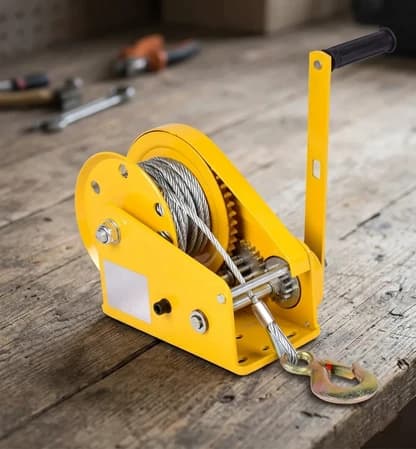
A Hand Winch is a mechanical device that uses manual effort through a handle, lever, or crank mechanism to wind or unwind a rope, cable, or wire rope around a drum. This mechanical action allows an operator to pull or position compatible loads in a controlled manner.
A Hand Operated Winch can be used for horizontal pulling, inclined movement, positioning, or suitable lifting applications depending on its design and rated capacity. The gearing and drum arrangement help convert manual input into controlled load movement.
A Manual Lifting Winch should be selected according to the working load, rope or wire rope arrangement, mounting position, required travel distance, and intended direction of movement. The actual capacity and permitted application vary by model and should always be verified according to the manufacturer's specifications.
Key Features & Benefits of Hand Winch
Manual Operation – Allows operation without an external electric or hydraulic power source.
Mechanical Load Control – Provides controlled pulling or positioning of compatible loads.
Durable Construction – Suitable construction can support repeated use in appropriate industrial conditions.
Heavy-Duty Options – A Heavy Duty Hand Winch can be selected for demanding applications within its specified working capacity.
Portable Use – A Portable Hand Winch can be useful where the equipment needs to be repositioned between suitable work areas.
Wire Rope Compatibility – A Wire Rope Hand Winch can be used where wire rope is appropriate for the application and winch design.
Practical Pulling Capability – Helps move or position compatible loads with controlled manual effort.
Compact Mechanical Design – Can be suitable for installations where simple manually operated equipment is preferred.
Application Flexibility – Can support pulling, positioning, recovery, and suitable lifting tasks depending on the model.
Low Power Dependency – Manual operation can be useful in locations where electrical or hydraulic power is unavailable.
Application-Based Selection – Capacity, rope type, mounting arrangement, and operating conditions should be matched to the intended use.
Applications of Hand Winch
A Hand Pulling Winch can be used wherever controlled manual pulling or positioning of compatible loads is required.
Material Handling – Supports pulling and positioning of suitable equipment and materials.
Workshop Applications – Used for compatible machinery movement, positioning, and maintenance tasks.
Warehouse Operations – Can assist with suitable manual movement and positioning of loads.
Equipment Installation – Supports controlled pulling or positioning during installation activities.
Fabrication Areas – Useful for moving and positioning compatible fabricated components.
Vehicle and Trailer Applications – Can be used for suitable pulling and positioning operations where the winch is properly rated.
Maintenance Operations – Supports equipment movement where manual mechanical operation is practical.
Industrial Handling Systems – Can be incorporated into suitable application-specific handling arrangements.
Recovery and Pulling Tasks – Suitable for compatible pulling applications within the manufacturer's rated limits.
A Manual Lifting Winch should always be used according to its intended application, rated capacity, mounting arrangement, and manufacturer's operating instructions.
Industries Served
Manufacturing Industry – Supports equipment positioning, material movement, and suitable workshop handling applications.
Engineering & Fabrication – Useful for pulling, positioning, and handling compatible machinery and fabricated components.
Warehousing & Logistics – Can assist with selected material movement and positioning requirements.
Automotive Industry – Suitable for compatible workshop, trailer, recovery, and vehicle-related applications.
Construction Industry – Can support suitable pulling and positioning tasks where manual operation is appropriate.
Industrial Maintenance – Helps move and position equipment during installation, servicing, and repair.
Agricultural Applications – Can be considered for compatible pulling and material movement tasks.
Workshops – Provides a practical manually operated solution for selected lifting and pulling requirements.
How to Choose the Right Hand Winch
Selecting the right Hand Winch Manufacturer is important, but the winch itself should also be matched carefully to the intended application.
Working Load – Select the winch according to the maximum load or pulling force required.
Pulling or Lifting Requirement – Determine whether the application requires horizontal pulling, inclined movement, positioning, or an approved lifting application.
Rope or Cable Type – Select a compatible rope, cable, or wire rope based on the winch design and application.
Rope Length – Consider the required travel distance and available winding capacity.
Mounting Arrangement – Verify that the winch can be securely mounted or positioned as required.
Gear Ratio – Consider the relationship between manual operating effort and required load movement.
Load Distribution – Ensure the pulling or lifting arrangement does not create unstable or uneven loading.
Operating Environment – Consider moisture, dust, temperature, corrosion, and other workplace conditions.
Frequency of Use – Select a suitable configuration for occasional or repeated manual operation.
Portability – Consider whether the winch needs to be transported or repositioned between applications.
Manufacturer Specifications – Confirm rated capacity, rope compatibility, mounting requirements, and operating limitations before use.
Businesses comparing a Hand Winch Supplier should evaluate the complete application rather than selecting a product based only on its advertised capacity.
Technical Considerations
The performance of an Industrial Hand Winch depends on rated capacity, gearing, drum arrangement, rope compatibility, mounting, load direction, and operating practices.
Confirm the specified working load or pulling capacity before use.
Check the drum dimensions and compatible rope or wire rope size.
Verify the mounting structure can withstand the applied load.
Inspect the handle, crank, gears, drum, and other mechanical components.
Check the rope or cable for wear, broken strands, kinks, deformation, or other damage where applicable.
Consider the line-pull requirement at the intended drum position.
Avoid side loading or operating conditions outside the manufacturer's intended application.
Ensure the pulling path is clear and the load remains stable during movement.
Do not exceed the rated capacity of the winch or connected components.
Use suitable anchoring and connection arrangements.
Follow the manufacturer's operating, inspection, and maintenance recommendations.
A Hand Operated Winch should be treated as part of a complete pulling or lifting system. The capacity and suitability of the overall arrangement depend on the winch, rope, anchoring point, load, and operating conditions.
Maintenance and Best Practices
Inspect Before Use – Check the winch body, handle, drum, gears, mounting points, and related components.
Check Rope or Wire Rope – Inspect for cuts, kinks, broken strands, corrosion, excessive wear, or other visible damage.
Inspect Gears – Check for unusual noise, excessive play, or abnormal operation.
Check Brake or Holding Mechanism – Where fitted, verify that the mechanism operates as intended.
Inspect Mounting Hardware – Ensure bolts, brackets, anchors, and other fasteners remain secure.
Keep the Winch Clean – Remove dust, dirt, debris, and contaminants that may affect mechanical operation.
Lubricate Applicable Parts – Follow manufacturer recommendations for gears, bearings, or other serviceable components.
Avoid Overloading – Never exceed the specified working or pulling capacity.
Store Correctly – Protect the winch and rope from unnecessary impact, moisture, and contamination.
Monitor Mechanical Condition – Remove equipment from service if cracks, deformation, severe wear, or malfunction is observed.
Inspect Mounting Points – Ensure the supporting structure remains suitable for the applied load.
Follow Preventive Maintenance – Schedule inspections according to operating frequency and manufacturer recommendations.
Proper maintenance helps maintain smooth mechanical operation and supports dependable pulling and positioning performance.
Why Choose Excelus Machineries?
Selecting a Hand Winch Manufacturer involves more than comparing winch size or rated capacity. Businesses should evaluate construction, load requirements, rope compatibility, mounting arrangement, operating environment, and technical support.
Excelus Machineries provides industrial material handling and lifting solutions designed around practical operational requirements. Hand winch selection can be considered according to the required pulling or lifting task, load characteristics, installation arrangement, and operating environment.
Key considerations include:
Industrial Experience – More than two decades of experience in material handling solutions.
Application-Focused Selection – Equipment is considered according to the actual pulling, lifting, or positioning requirement.
Material Handling Expertise – Supports suitable industrial, workshop, and equipment handling applications.
Technical Guidance – Helps customers evaluate capacity, rope compatibility, mounting, and application conditions.
Customized Support – Suitable for application-specific manual winch requirements.
Quality-Focused Approach – Solutions are considered for practical industrial operating conditions.
After-Sales Support – Assistance for product-related and replacement requirements.
Industrial Customer Support – Suitable for procurement teams, engineers, maintenance personnel, and equipment users.
For businesses evaluating a Hand Winch Supplier, important factors include working load, pulling requirement, rope or cable type, rope length, mounting arrangement, operating environment, and frequency of use.
Conclusion
A Hand Winch is a practical mechanical solution for controlled pulling, positioning, and suitable lifting applications where manual operation is preferred or external power is unavailable. Depending on the application, a Manual Hand Winch, Heavy Duty Hand Winch, Portable Hand Winch, or Wire Rope Hand Winch can be selected according to the required load and operating conditions.
Whether used for industrial material handling, workshop operations, equipment positioning, maintenance, or compatible pulling tasks, the winch should be selected according to working capacity, rope arrangement, mounting requirements, load direction, operating environment, and manufacturer specifications. As a Hand Winch Manufacturer and Hand Winch Supplier, Excelus Machineries focuses on application-based industrial material handling and lifting solutions.