Description
What is a CI Rubber Model Wheel?
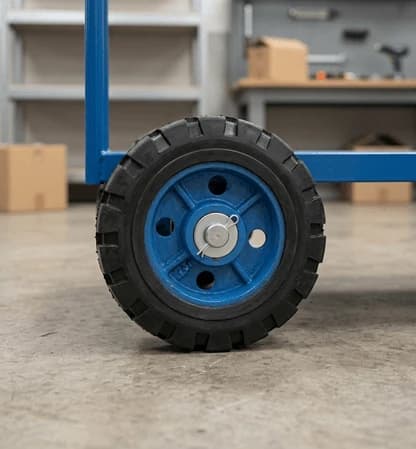
A CI Rubber Model Wheel is a wheel that uses cast iron as its structural core and rubber as the outer running surface. This combination is designed for compatible industrial equipment where both mechanical support and a suitable floor-contact material are required.
A Cast Iron Wheel with Rubber can be used on trolleys, carts, material handling equipment, workstations, and other mobile systems. The cast iron core provides the structural base, while the rubber surface provides the contact between the wheel and floor.
The actual load capacity, wheel diameter, tread thickness, bearing arrangement, mounting configuration, and environmental suitability vary according to the product design. These specifications should be selected according to the manufacturer's recommendations and the intended application.
Key Features & Benefits of CI Rubber Model Wheel
Cast Iron Core – Provides a robust structural base for suitable industrial wheel applications.
Rubber Running Surface – Provides suitable floor contact and rolling characteristics when correctly matched to the application.
Load Support – Supports compatible equipment and loads within the specified rated capacity.
Heavy-Duty Construction – Suitable configurations can be used for demanding material handling applications.
Smooth Equipment Movement – Helps provide controlled movement across suitable industrial floors.
Reduced Floor Impact – The rubber running surface can provide a more forgiving contact than a bare metal wheel on compatible floors.
Multiple Wheel Sizes – Different diameters and widths can be selected according to equipment requirements.
Bearing Options – Bearing arrangements can be matched to load and movement requirements.
Industrial Application Suitability – Suitable for carts, trolleys, workstations, platforms, and other compatible equipment.
Application-Based Configuration – Wheel size, tread, bearing, and mounting arrangement can be selected according to the intended use.
Applications of CI Rubber Model Wheel
A Material Handling Rubber Wheel can be used wherever compatible industrial equipment requires dependable floor-level mobility.
Material Handling Trolleys – Supports movement of tools, components, containers, and industrial materials.
Industrial Carts – Helps move carts through warehouses, workshops, and production areas.
Workstations – Allows compatible workstations and service units to be repositioned when required.
Warehouse Equipment – Supports movement of suitable platforms, racks, carts, and handling systems.
Maintenance Equipment – Used on compatible tool carts and mobile service equipment.
Manufacturing Facilities – Supports mobility of production support equipment and industrial trolleys.
Engineering Workshops – Helps move components, tools, equipment, and mobile workstations.
Industries Served
Manufacturing Plants – Supports movement of production and material handling equipment.
Engineering & Fabrication – Helps move components, tools, and industrial workstations.
Warehousing & Logistics – Assists with carts, trolleys, storage equipment, and handling units.
Automotive Industry – Suitable for compatible service carts and workshop equipment.
Packaging Industry – Supports movement of suitable production and handling equipment.
Industrial Maintenance – Helps move service units, mobile tools, and maintenance equipment.
Industrial Workshops – Provides practical wheel solutions for equipment mobility.
How to Choose the Right CI Rubber Model Wheel
Selecting the right CI Rubber Model Wheel requires evaluation of the equipment, load, floor, wheel configuration, and operating conditions.
Load Capacity – Determine the maximum combined weight of the equipment and load.
Load Distribution – Consider how the total weight is transferred across individual wheels.
Wheel Diameter – Select a diameter appropriate for the floor surface and required movement.
Wheel Width – Match the width to the equipment and expected loading.
Rubber Surface – Consider the required wheel-to-floor contact and application conditions.
Bearing Arrangement – Select a suitable bearing type for the expected load and movement.
Mounting Configuration – Verify compatibility with the trolley, cart, castor, or equipment frame.
Fixed or Swivel Use – Determine whether directional control or maneuverability is required.
Floor Conditions – Consider joints, ramps, uneven surfaces, debris, and floor finish.
Operating Environment – Review moisture, temperature, chemicals, dust, and other workplace conditions.
Frequency of Movement – Match wheel construction to expected usage and travel frequency.
For applications requiring a Customized Rubber Wheel, dimensions, mounting, bearing, and other requirements should be confirmed before production or supply.
Technical Considerations
The performance of a CI Rubber Wheel depends on wheel construction, rated capacity, rubber surface, cast iron core, load distribution, bearing arrangement, mounting, floor condition, and operating practices.
Check Rated Capacity – Ensure the wheel is suitable for the actual operating load.
Evaluate Load per Wheel – Consider uneven loading rather than assuming equal distribution.
Inspect Rubber Surface – Check for excessive wear, cuts, cracking, separation, or deformation.
Check Cast Iron Core – Inspect for cracks, damage, corrosion, or structural defects.
Inspect Bearings – Check for abnormal noise, looseness, or increased rolling resistance.
Verify Mounting Components – Inspect axles, brackets, plates, stems, and fasteners.
Check Wheel Alignment – Ensure the wheel is correctly aligned with the equipment.
Review Floor Compatibility – Confirm the rubber wheel is appropriate for the intended surface.
Consider Environmental Conditions – Evaluate temperature, moisture, chemicals, oils, and other relevant exposure.
Avoid Overloading – Do not exceed the manufacturer's specified capacity or operating limits.
Regular inspection of both the rubber running surface and cast iron structure helps maintain dependable wheel performance.
Maintenance and Best Practices
Inspect Before Use – Check the wheel, rubber surface, cast iron body, axle, bearings, and mounting components.
Monitor Rubber Wear – Look for cracks, cuts, flat spots, peeling, or excessive tread wear.
Inspect Cast Iron Core – Check for cracks, deformation, corrosion, or other structural damage.
Check Bearings – Ensure rotation remains smooth and free from abnormal noise or resistance.
Check Mounting Hardware – Ensure bolts, nuts, plates, stems, and related fasteners remain secure.
Inspect Axles & Brackets – Check for bending, looseness, wear, or visible damage.
Keep Wheels Clean – Remove debris and contaminants that may affect rolling performance.
Monitor Load Distribution – Avoid uneven loading that could overstress individual wheels.
Avoid Overloading – Never exceed the rated capacity of the wheel or complete assembly.
Maintain Suitable Floors – Keep travel surfaces free from avoidable obstacles and conditions unsuitable for the wheel.
Lubricate Applicable Components – Follow manufacturer recommendations for serviceable bearings.
Replace Damaged Wheels – Replace wheels showing significant rubber or structural damage.
Follow Preventive Maintenance – Include wheel assemblies in routine equipment inspection and servicing.
Why Choose Excelus Machineries?
Selecting a CI Rubber Model Wheel supplier or manufacturer involves more than comparing wheel dimensions and price. Businesses should evaluate load capacity, wheel construction, mounting compatibility, bearing arrangement, floor conditions, operating environment, and application suitability.
Excelus Machineries provides industrial material handling and mobility solutions designed around practical operational requirements.
Key advantages include:
Durable industrial wheel solutions
Application-focused wheel selection
Support for trolley and material handling equipment
Suitable cast iron and rubber wheel configurations
Technical assistance during product selection
Customization support for specific applications
Maintenance and operational guidance
Practical industrial mobility solutions
For businesses looking for a CI Rubber Model Wheel manufacturer or CI Rubber Model Wheel supplier, providing details such as equipment type, total load, wheel dimensions, mounting arrangement, floor condition, and operating frequency helps identify a suitable configuration.
Conclusion
A CI Rubber Model Wheel provides a practical wheel solution for trolleys, carts, workstations, platforms, and other compatible industrial equipment. Its cast iron construction provides a strong structural base, while the rubber running surface is designed to provide suitable floor contact and rolling performance for compatible applications.
Whether specified as a CI Rubber Wheel, Cast Iron Rubber Wheel, Cast Iron Wheel with Rubber, Heavy Duty Rubber Wheel, or Customized Rubber Wheel, the wheel should be selected according to load capacity, wheel dimensions, bearing arrangement, mounting configuration, floor conditions, and operating environment. Excelus Machineries provides industrial mobility and material handling solutions designed around practical application requirements, helping businesses select suitable wheel configurations for dependable equipment movement.